Aurora Borealis 2026: Northern US Viewing Guide
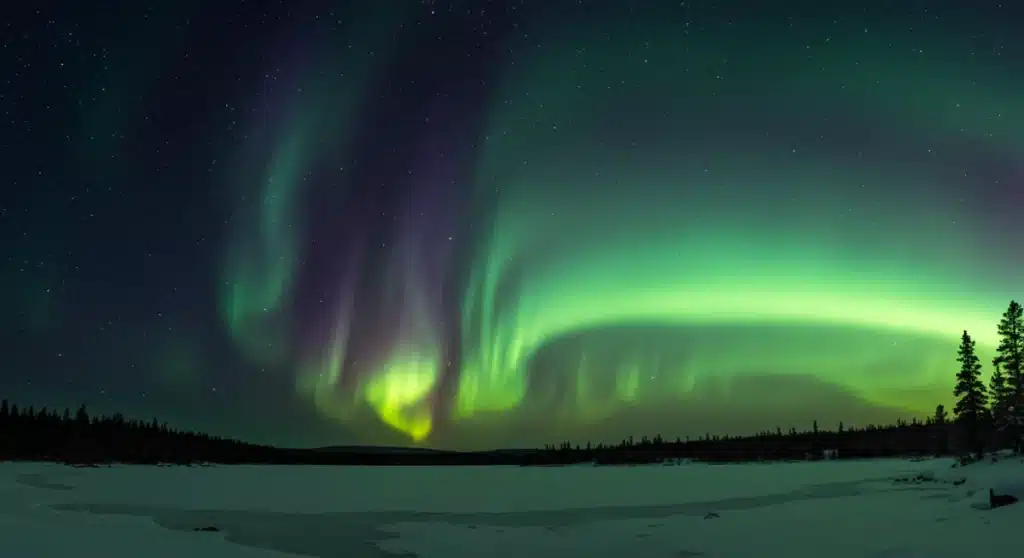
The 2026 solar maximum promises a 70% increased chance of viewing the Northern Lights in Northern US states; this guide provides practical solutions for predicting and successfully experiencing the dazzling Aurora Borealis.
Prepare for an astronomical spectacle as the Aurora Borealis in 2026: Practical Solutions for Predicting and Viewing the Northern Lights in Northern US States, with a 70% Chance Increase becomes a reality. This guide is your essential companion to understanding, predicting, and ultimately witnessing one of Earth’s most breathtaking natural light shows, particularly as the solar maximum approaches.
Understanding the 2026 Solar Maximum and Aurora Potential
The year 2026 is poised to be an extraordinary period for aurora enthusiasts, largely due to the anticipated peak of the solar cycle, known as the solar maximum. This period is characterized by heightened solar activity, including more frequent and intense solar flares and coronal mass ejections (CMEs), which are the primary drivers of auroral displays. Predictive models suggest a significant increase in the likelihood of visible auroras, even in latitudes further south than typically expected.
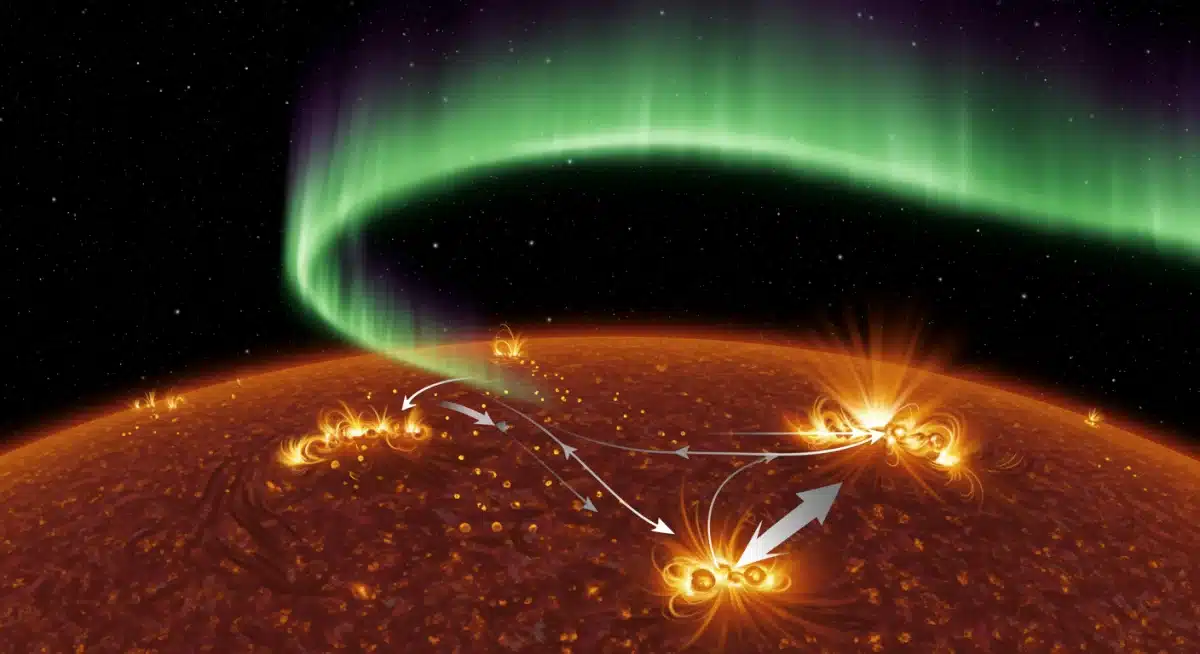
During the solar maximum, the sun’s magnetic field becomes more complex, leading to an increased number of sunspots. These sunspots are often the origin points for the powerful eruptions that send charged particles hurtling towards Earth. When these particles interact with our planet’s magnetic field and atmosphere, they create the stunning light show we call the aurora. The 70% chance increase is a compelling statistic, offering a rare window of opportunity for viewers in the Northern US states.
The Science Behind the Spectacle
The aurora is a natural light display in Earth’s sky, predominantly seen in high-latitude regions. It results from disturbances in the magnetosphere caused by solar wind. These disturbances, primarily CMEs, cause the energized particles to collide with atoms and molecules in Earth’s upper atmosphere. The energy released during these collisions is emitted as light, creating the vibrant colors of the aurora.
- Solar Wind: A stream of charged particles released from the sun’s upper atmosphere.
- Coronal Mass Ejections (CMEs): Large expulsions of plasma and magnetic field from the sun’s corona.
- Magnetosphere: The region of space surrounding an astronomical object in which its magnetic field is the predominant effective magnetic field.
- Atmospheric Interaction: Charged particles excite atmospheric gases, causing them to emit light.
Understanding these fundamental principles is crucial for appreciating why 2026 holds such promise. The increased intensity and frequency of solar events directly translate to a higher probability of auroral activity, making preparedness key for those hoping to view this natural wonder.
Prime Northern US States for Aurora Viewing in 2026
While the aurora is most commonly associated with polar regions, the heightened solar activity in 2026 significantly extends the potential viewing areas into the Northern US states. Several states, particularly those bordering Canada or with minimal light pollution, offer excellent opportunities for catching a glimpse of the Northern Lights. Knowing where to go is just as important as knowing when.
States like Alaska, naturally, are always prime locations. However, with the increased solar activity, states such as North Dakota, Montana, Minnesota, Michigan, Maine, and even parts of Wisconsin and New York, will see their chances dramatically improve. These areas share common characteristics that make them ideal: northern latitude, vast open spaces, and often, a commitment to reducing light pollution.
Top Locations and Why They Stand Out
- Alaska: Always a top contender, with Fairbanks and Anchorage being popular spots due to their high latitude and organized viewing tours.
- Northern Michigan (Upper Peninsula): Offers dark skies over Lake Superior, providing stunning reflections of the aurora.
- Northern Minnesota (Boundary Waters Canoe Area Wilderness): Known for its exceptionally dark skies and wilderness appeal, perfect for an immersive experience.
- Montana (Glacier National Park area): Remote and pristine, offering incredible backdrops for aurora photography.
- North Dakota: Its flat, open plains provide expansive views of the horizon, ideal for catching low-lying auroras.
- Maine (Acadia National Park): While further east, its dark skies on clear nights can offer surprising views during strong solar events.
Choosing the right location involves more than just geographical coordinates; it’s also about finding places away from urban glow. National parks and remote state forests often provide the best conditions for a truly unobstructed view of the night sky, enhancing your chances of witnessing the elusive Northern Lights.
Predicting the Aurora: Tools and Resources for 2026
Successful aurora viewing hinges significantly on accurate prediction. Fortunately, an array of sophisticated tools and resources are available to help enthusiasts forecast auroral activity. These tools leverage real-time space weather data, offering crucial insights into when and where the lights might appear, especially vital for maximizing the 70% increased chance in 2026.
The key to prediction lies in monitoring solar wind speed, the Bz component of the interplanetary magnetic field (IMF), and the Kp index. A fast solar wind, a southward Bz, and a high Kp index (typically 4 or higher for Northern US viewing) are strong indicators of potential auroral displays. Understanding how to interpret these metrics will elevate your viewing strategy from hopeful waiting to informed anticipation.

Essential Prediction Tools
- NOAA Space Weather Prediction Center (SWPC): Provides official forecasts, alerts, and real-time data on solar activity and geomagnetic storms. Their 30-minute and 3-day aurora forecasts are invaluable.
- Aurora Forecast Apps: Numerous mobile applications, such as ‘My Aurora Forecast’ or ‘Aurora Alerts’, aggregate data from various sources and provide user-friendly alerts and probability maps.
- Kp Index Trackers: Websites and apps that specifically track the Kp index, a measure of geomagnetic activity. Real-time updates help determine current auroral strength.
- Magnetometer Data: For advanced users, monitoring local magnetometer readings can indicate real-time geomagnetic disturbances.
Beyond these tools, joining online communities and forums dedicated to aurora chasing can provide real-time ground reports and tips from experienced observers. The collective knowledge of these communities can be a powerful asset in your quest to see the Northern Lights.
Optimizing Your Viewing Experience: Practical Tips
Even with the increased chances in 2026, successful aurora viewing requires careful planning and execution. Beyond knowing when and where, understanding how to optimize your viewing experience can make the difference between a fleeting glimpse and an unforgettable spectacle. These practical tips cover everything from preparation to on-site strategies.
The most critical element, aside from solar activity, is clear, dark skies. Light pollution is the aurora’s biggest enemy. Therefore, choosing a location far from city lights is paramount. Furthermore, checking local weather forecasts for cloud cover is essential, as even a strong aurora can be obscured by an overcast sky. Patience is also a virtue; auroras can appear suddenly and disappear just as quickly, so be prepared to wait.
Key Strategies for Aurora Chasers
- Escape Light Pollution: Drive at least an hour or more away from major cities. Use light pollution maps online to find the darkest skies.
- Check Weather Forecasts: Clear skies are non-negotiable. Look for nights with low cloud cover.
- Dress Warmly: Northern US nights, even in spring or fall, can be very cold, especially when standing still outdoors for extended periods. Layered clothing, insulated boots, hats, and gloves are crucial.
- Allow Eyes to Adjust: Give your eyes at least 20-30 minutes to adapt to the darkness for optimal viewing. Avoid looking at bright screens during this time.
- Bring a Red-Light Flashlight: Red light helps preserve your night vision, unlike white light which can ruin it instantly.
- Patience and Persistence: Auroras can be unpredictable. Be prepared to wait, and don’t get discouraged if nothing appears immediately.
For those interested in photography, a sturdy tripod, a wide-angle lens, and knowledge of manual camera settings (high ISO, wide aperture, long exposure) are indispensable. Capturing the aurora on camera can be just as rewarding as seeing it with your own eyes, creating lasting memories of this cosmic event.
Photography and Documentation of the Northern Lights
Capturing the ephemeral beauty of the Aurora Borealis is a goal for many who venture into the night. With the increased activity expected in 2026, perfecting your aurora photography skills will allow you to immortalize these spectacular moments. While the human eye perceives the aurora differently, a camera can often capture more vibrant colors and details, making a well-executed photograph truly stunning.
Successful aurora photography requires a combination of the right equipment and an understanding of specific camera settings. It’s not just about pointing and shooting; it’s about mastering long exposure techniques and managing light in extremely dark environments. Practice beforehand with night sky photography to get comfortable with your gear and settings.
Essential Photography Gear and Settings
- Camera: A DSLR or mirrorless camera with good low-light performance.
- Lens: A wide-angle lens (14mm-24mm) with a fast aperture (f/2.8 or wider) is ideal for capturing the expansive sky.
- Tripod: Absolutely essential for long exposures to prevent camera shake.
- Remote Shutter Release: Minimizes camera shake when pressing the shutter button.
- Extra Batteries: Cold weather drains batteries quickly. Keep spares warm in an inside pocket.
- Manual Focus: Set your lens to manual focus and focus to infinity.
- ISO: Start with ISO 1600-3200, adjust based on light conditions.
- Aperture: Set to its widest (e.g., f/2.8, f/4).
- Shutter Speed: Begin with 10-20 seconds; adjust shorter for brighter, faster-moving auroras, longer for fainter ones.
Post-processing software can further enhance your aurora images, bringing out colors and details that might be subtle in the raw capture. Always shoot in RAW format to retain maximum image data for editing. Sharing your photos can also contribute to citizen science, helping others track and appreciate the aurora.
Beyond 2026: The Future of Aurora Viewing and Research
While 2026 marks a significant peak for aurora viewing, the fascination with the Northern Lights and the science behind them extends far beyond this single year. Ongoing research into space weather, solar cycles, and Earth’s magnetosphere continues to deepen our understanding of these cosmic events, promising even more refined predictions and public engagement in the future.
The data collected during periods of high solar activity, like the upcoming solar maximum, is invaluable for scientists. It helps them build more accurate models, improve forecasting capabilities, and even understand the potential impacts of severe space weather on our technology and infrastructure. Public interest and citizen science initiatives also play a crucial role in expanding this knowledge base.
Advancements and Long-Term Prospects
- Improved Space Weather Monitoring: New satellites and ground-based observatories provide more comprehensive data on solar activity and geomagnetic conditions.
- Enhanced Predictive Algorithms: Machine learning and AI are being applied to space weather data to create more accurate and timely aurora forecasts.
- Citizen Science Contributions: Public reports and photographs of auroral displays contribute valuable ground-truth data for researchers.
- Educational Outreach: Increased awareness and educational programs help the public understand and appreciate the science of auroras.
The cyclical nature of the sun means that while 2026 is a highlight, there will always be future opportunities to witness the aurora. Staying informed about solar activity and supporting scientific research ensures that the magic of the Northern Lights remains accessible and understandable for generations to come, fostering a deeper connection with our cosmic environment.
| Key Aspect | Brief Description |
|---|---|
| 2026 Solar Maximum | Anticipated peak of solar activity, significantly increasing aurora visibility. |
| Northern US Viewing | States like Michigan, Minnesota, and Montana offer prime viewing spots. |
| Prediction Tools | Utilize NOAA SWPC, Kp index, and apps for accurate forecasts. |
| Viewing Optimization | Seek dark skies, check weather, dress warmly, and allow eye adjustment. |
Frequently Asked Questions About the 2026 Aurora
2026 is projected to be the peak of the solar cycle, known as the solar maximum. This period sees heightened solar activity, leading to more frequent and intense solar flares and coronal mass ejections, which significantly increase the likelihood of visible auroras further south in the Northern US states.
States with high northern latitudes and minimal light pollution will have the best chances. Key states include Alaska, North Dakota, Montana, Minnesota, Michigan (Upper Peninsula), and Maine. Even parts of Wisconsin and New York may experience enhanced visibility during strong events.
The NOAA Space Weather Prediction Center (SWPC) provides official forecasts and alerts. Additionally, mobile apps like ‘My Aurora Forecast’ and websites that track the Kp index are invaluable for real-time updates and geomagnetic activity levels.
Essential items include warm layered clothing, insulated boots, a red-light flashlight to preserve night vision, and a sturdy tripod if you plan to photograph. Patience and hot beverages are also highly recommended for long waits in cold conditions.
While dedicated cameras offer superior results, modern smartphones with manual mode capabilities can capture decent aurora photos. Look for settings allowing longer exposure times (10-30 seconds) and higher ISO. Using a tripod or stable surface is crucial for any successful night sky photography with a smartphone.
Conclusion
The anticipation for the Aurora Borealis in 2026: Practical Solutions for Predicting and Viewing the Northern Lights in Northern US States, with a 70% Chance Increase is building, offering an unparalleled opportunity for skygazers across the Northern US. By understanding the science of the solar maximum, identifying prime viewing locations, utilizing predictive tools, and preparing meticulously, you significantly enhance your chances of witnessing this celestial marvel. This guide serves as your comprehensive resource, ensuring you are well-equipped to experience the magic of the Northern Lights. As 2026 approaches, stay informed, stay patient, and prepare for an unforgettable display that underscores the profound beauty of our cosmos.