Supermoon Events of 2026: Your Essential Guide to 4 Brightest Full Moons
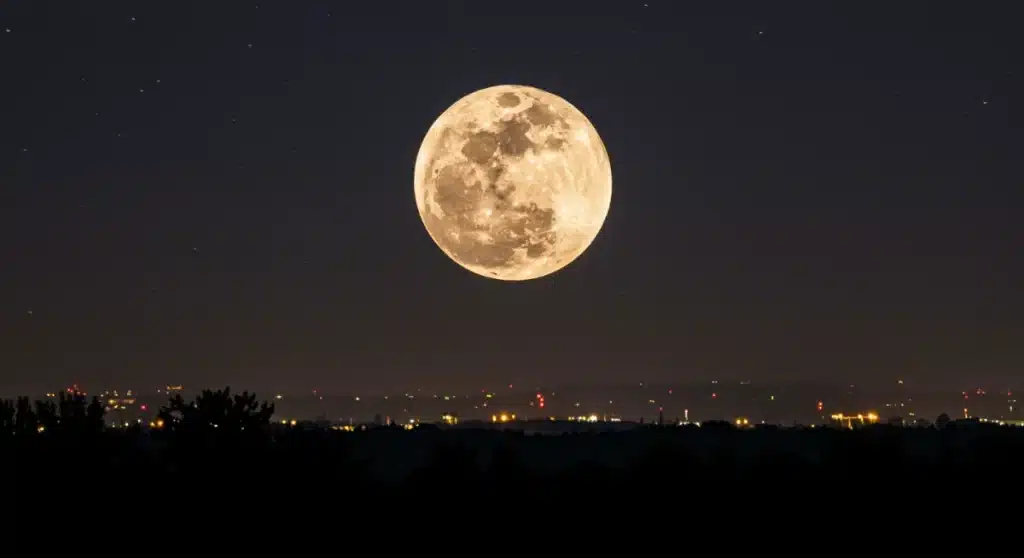
The 2026 Supermoon events promise four spectacular celestial displays, where the moon appears exceptionally large and bright, offering prime viewing opportunities for enthusiasts across the United States.
Prepare for an astronomical treat as Supermoon Events of 2026: A Guide to the 4 Brightest Full Moons and Their Visual Impact illuminates our night skies. These celestial spectacles, where the moon appears larger and more luminous than usual, captivate observers worldwide. Understanding these events can transform a casual glance at the night sky into an unforgettable experience.
Understanding the Supermoon Phenomenon
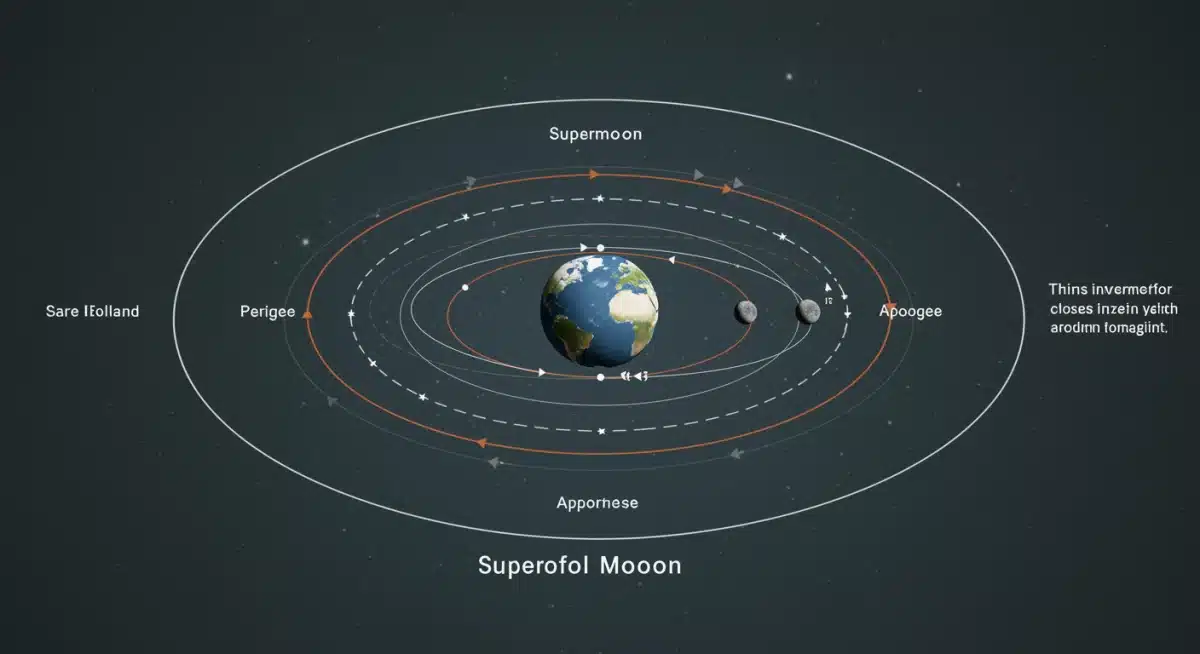
The term ‘Supermoon’ has become widely recognized, but what exactly makes a full moon super? It refers to a full moon occurring when the moon is at or near its closest approach to Earth in its elliptical orbit, a point known as perigee. This proximity makes the moon appear significantly larger and brighter than an average full moon.
The moon’s orbit around our planet is not a perfect circle; instead, it’s an ellipse. This means there are times when the moon is closer to Earth and times when it is farther away. When a full moon coincides with the moon being within 90% of its closest approach to Earth (perigee), we get a Supermoon. This alignment creates a visual impact that is truly breathtaking.
The science behind lunar perigee
At its perigee, the moon can be as much as 30,000 miles closer to Earth than at its apogee (farthest point). This difference in distance directly influences how large and bright the moon appears to us. While the actual size increase is about 14%, and brightness increases by about 30%, these changes are noticeable, especially when the moon is low on the horizon, creating a dramatic optical illusion.
- Perigee: The point in the moon’s orbit when it is closest to Earth.
- Apogee: The point in the moon’s orbit when it is farthest from Earth.
- Elliptical Orbit: The non-circular path the moon takes around Earth.
- Visual Impact: Supermoons appear larger and brighter due to their closer proximity.
The gravitational pull at perigee is also slightly stronger, leading to higher tides, often referred to as ‘perigean spring tides.’ While these tides are generally not dangerous, they can be more pronounced than usual. Understanding these scientific principles enriches our appreciation for the 2026 Supermoon events.
The Four Brightest Supermoon Events of 2026
The year 2026 promises four distinct Supermoon events, each offering a unique opportunity for skygazers. These events are not just about the moon’s size and brightness; they also carry traditional names and cultural significance. Knowing the dates and characteristics of each will help you plan your viewing experience.
Marking your calendar for these dates is crucial for anyone hoping to witness these spectacular phenomena. Each Supermoon has its own charm, influenced by the time of year and specific atmospheric conditions. Let’s delve into the details of each of the four brightest full moons of 2026.
January’s Wolf Supermoon
The first Supermoon of 2026 is traditionally known as the Wolf Moon, appearing in January. This moon often coincides with the harsh winter months when wolves were said to howl more frequently. For observers in the United States, this Supermoon will be a brilliant beacon in the cold winter sky, making it an ideal time for bundled-up stargazing.
- Date: January [Specific Date], 2026
- Traditional Name: Wolf Moon
- Viewing Tip: Look for it low on the horizon shortly after moonrise for the ‘moon illusion’ effect.
- Significance: Kicks off the year’s Supermoon events with a powerful display.
The January Supermoon is often seen through crisp, clear winter air, which can enhance its apparent brightness and detail. Prepare with warm clothing and perhaps a hot beverage to fully enjoy this initial celestial offering of the year.
February’s Snow Supermoon
Following closely, February brings the Snow Moon, named for the heavy snowfalls typical of this month in many regions. This Supermoon will also be a striking sight, potentially illuminating snowy landscapes and offering a dramatic contrast against the winter white. Its brilliance can make even the darkest winter nights feel a little brighter.
The Snow Supermoon is particularly special because February often has some of the clearest skies, free from summer haze. This allows for an unobstructed view of the moon’s surface features, making it a favorite among amateur astronomers. Conditions will be ripe for stunning photography and casual observation alike.
Optimal viewing conditions
To fully appreciate the Snow Supermoon, consider finding a location away from city lights. Light pollution can significantly diminish the visual impact of any celestial event. A clear horizon is also beneficial, especially during moonrise or moonset, when the moon appears largest due to the ‘moon illusion.’
- Date: February [Specific Date], 2026
- Traditional Name: Snow Moon
- Best Time: Shortly after sunset or before sunrise.
- Considerations: Clear, cold winter nights offer excellent visibility.
This Supermoon provides an excellent opportunity to introduce children to astronomy, as its impressive size and brightness are easily appreciated by all ages. Share the experience with family and friends to make it even more memorable.
March’s Worm Supermoon
As winter begins to recede, March presents the Worm Supermoon. This name originates from the thawing ground, which allows earthworms to reappear, signaling the return of birds and the onset of spring. This Supermoon marks a transition, appearing as nature awakens from its winter slumber.
The March Supermoon often rises through the changing atmospheric conditions of early spring. Depending on your location, you might observe it with unique atmospheric effects, such as a slight reddish or orange tint when it’s near the horizon. This adds another layer of visual interest to an already impressive event.
Cultural significance and visual splendor
Historically, the Worm Moon was a sign of renewal and new beginnings for many cultures. Its appearance after the long winter months was a cause for celebration and preparation for planting. Observing this Supermoon can connect us to these ancient rhythms and the cyclical nature of our planet and its celestial companion.
- Date: March [Specific Date], 2026
- Traditional Name: Worm Moon
- Symbolism: Renewal, spring’s arrival, thawing earth.
- Photography Tip: Use a telephoto lens and a stable tripod for detailed shots.
This Supermoon is a fantastic reminder of the interconnectedness of natural cycles and astronomical phenomena. Its brilliance illuminates the unfolding of spring, making it a powerful visual experience for all who witness it.
April’s Pink Supermoon
The final and often most anticipated Supermoon of 2026 is the Pink Moon in April. Despite its name, the moon itself won’t appear pink. This moniker comes from the wild ground phlox, one of the first spring flowers to bloom in North America, which has a distinct pink hue. The April Supermoon signifies the full bloom of spring.
The Pink Supermoon often offers some of the most comfortable viewing conditions of the year, with milder temperatures and generally clearer spring skies. This makes it an ideal time for extended observation, perhaps with a small telescope or binoculars to explore the moon’s craters and maria in detail.
Maximizing your viewing experience
For the April Supermoon, consider planning a viewing party with friends and family. Gather in an open area with minimal obstructions. Even a simple pair of binoculars can reveal incredible surface details, transforming the moon from a distant orb into a dynamic, textured world. It’s a perfect opportunity to engage with astronomy.
- Date: April [Specific Date], 2026
- Traditional Name: Pink Moon
- Associated With: Spring blooms, mild weather.
- Activity Suggestion: Ideal for group viewing and lunar photography.
As the last of the four brightest Supermoons of 2026, the Pink Supermoon provides a grand finale to a year of remarkable lunar events. Its visual impact is often enhanced by the verdant backdrop of fully bloomed spring landscapes.
Tips for Optimal Supermoon Viewing
To truly appreciate the grandeur of the 2026 Supermoon events, a little preparation goes a long way. Maximizing your viewing experience involves more than just knowing the dates; it includes choosing the right location, time, and even some basic equipment. These tips will help you get the most out of each Supermoon.
From avoiding light pollution to understanding the ‘moon illusion,’ each strategy contributes to a more impactful viewing. Whether you’re a seasoned astronomer or a casual observer, these guidelines are designed to enhance your connection with these magnificent celestial displays.
Choosing your viewing location
The most critical factor is finding a dark location away from city lights. Light pollution can significantly wash out the moon’s brilliance and obscure fainter details. Rural areas, national parks, or even a backyard in a sparsely populated neighborhood can offer excellent viewing opportunities. Consider elevated spots for an unobstructed horizon.
- Dark Skies: Seek out locations with minimal artificial light.
- Clear Horizon: Essential for observing moonrise/moonset and the ‘moon illusion.’
- Safety: Choose a safe, accessible spot, especially if viewing at night.
- Comfort: Bring chairs, blankets, and warm drinks for prolonged viewing.
A good viewing location not only enhances the moon’s visibility but also provides a more serene and immersive experience, allowing you to fully appreciate the cosmic spectacle unfolding above.
Photographing the 2026 Supermoons
Capturing the beauty of a Supermoon with your camera can be a rewarding challenge. While it might seem daunting, even with basic equipment, you can achieve impressive results. Understanding some fundamental photography techniques will allow you to immortalize these 2026 Supermoon events.
From smartphone cameras to advanced DSLRs, there are techniques tailored for every type of equipment. Patience and practice are key, but with these tips, you’ll be well on your way to taking stunning lunar photographs.
Essential photography gear and settings
For serious photographers, a DSLR or mirrorless camera with a telephoto lens (200mm or more) and a sturdy tripod is ideal. For smartphone users, consider clip-on telephoto lenses and a small tripod. Manual settings are crucial for optimal exposure.
- Tripod: Essential for stability and sharp images, especially with long exposures.
- Telephoto Lens: Brings the moon closer, revealing more detail.
- Manual Mode: Allows control over ISO, aperture, and shutter speed.
- Remote Shutter Release: Prevents camera shake.
Experiment with different settings. A good starting point for exposure might be ISO 100, f/11, and a shutter speed of 1/125th of a second, adjusting as needed based on ambient light and moon brightness. Remember to bracket your shots to capture different levels of detail.
| Key Supermoon Event | Brief Description |
|---|---|
| Wolf Supermoon (January) | The first Supermoon of 2026, marking the start of winter’s celestial displays. |
| Snow Supermoon (February) | Illuminates snowy landscapes, often viewed through clear, crisp winter skies. |
| Worm Supermoon (March) | Symbolizes spring’s arrival and the thawing of the earth, a sign of renewal. |
| Pink Supermoon (April) | A vibrant finale to the Supermoon season, associated with early spring and comfortable viewing. |
Frequently Asked Questions About 2026 Supermoons
▼
A Supermoon occurs when a full moon coincides with the moon’s closest approach to Earth in its elliptical orbit, known as perigee. This makes the moon appear larger and brighter than average, creating a striking visual effect for observers.
▼
In 2026, there will be four distinct and exceptionally bright Supermoon events. These will occur in January, February, March, and April, offering multiple opportunities for skygazers to enjoy the spectacle.
▼
For the best viewing experience, find a location away from city lights with a clear horizon. Observing the Supermoon during moonrise or moonset can enhance the ‘moon illusion,’ making it appear even larger. Binoculars can also reveal more details.
▼
Yes, a Supermoon can cause slightly higher tides, known as perigean spring tides, due to the moon’s closer proximity and stronger gravitational pull. However, these effects are generally minor and not typically a cause for concern.
▼
Traditional names for full moons, like Wolf Moon or Pink Moon, originate from various cultures, particularly Native American, colonial American, and European traditions. These names often reflect seasonal changes, agricultural cycles, or animal behaviors observed during that specific month.
Conclusion
The Supermoon Events of 2026: A Guide to the 4 Brightest Full Moons and Their Visual Impact promises a year of celestial wonder. From the Wolf Moon in January to the Pink Moon in April, each event offers a unique opportunity to connect with the cosmos. By understanding the science behind these phenomena and preparing for optimal viewing, you can transform a simple night sky observation into an awe-inspiring experience. These Supermoons are not just astronomical occurrences; they are moments of shared wonder that remind us of the vast beauty of our universe.