2026 Perihelion & Aphelion: Earth’s Orbital Variations
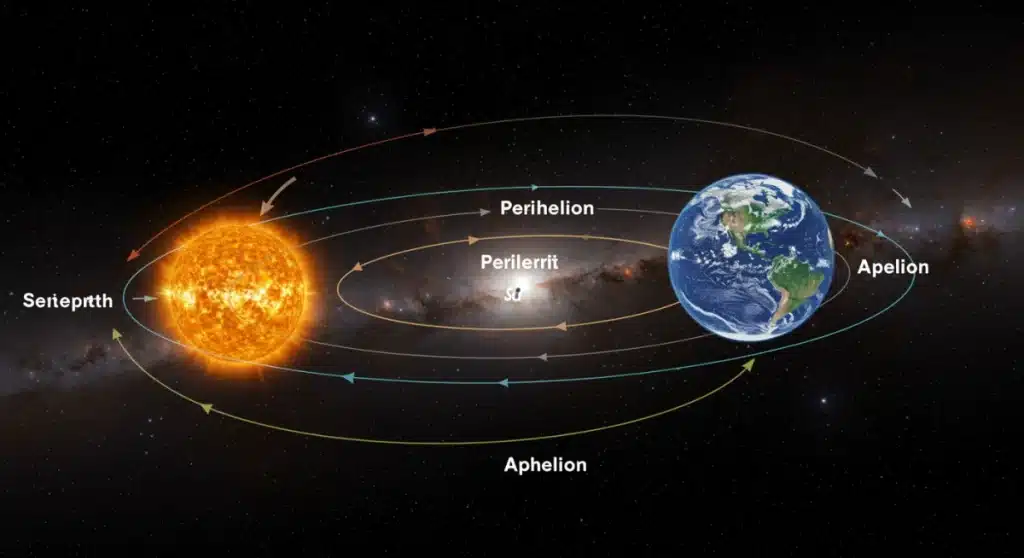
The 2026 perihelion and aphelion mark Earth’s closest and farthest points from the Sun, respectively, subtly influencing seasonal cycles and global climate patterns through variations in solar radiation.
As we navigate through time, our planet Earth embarks on a fascinating annual journey around the Sun, a celestial dance governed by gravitational forces and cosmic mechanics. Understanding Earth’s Orbital Variations 2026, specifically the perihelion and aphelion, offers profound insights into the subtle yet significant ways these astronomical events influence our world. These aren’t just abstract concepts for astronomers; they play a role in everything from seasonal intensities to long-term climate trends, making them a crucial topic for anyone curious about our place in the universe.
Understanding Perihelion and Aphelion
The terms perihelion and aphelion describe two critical points in Earth’s elliptical orbit around the Sun. These are the moments when our planet is either closest to or farthest from our star, respectively. While many might assume these distances dictate our seasons, the reality is far more nuanced and fascinating, involving a complex interplay of orbital mechanics and axial tilt.
Earth’s orbit is not a perfect circle, but rather an ellipse. This means there are times when Earth is nearer to the Sun and times when it is farther away. These variations, though seemingly small in the grand scheme of cosmic distances, have measurable effects on the amount of solar radiation Earth receives, impacting various planetary processes.
The Dynamics of Orbital Distance
- Perihelion: This is the point in Earth’s orbit when it is closest to the Sun. It typically occurs in early January, meaning the Northern Hemisphere experiences winter during this time.
- Aphelion: Conversely, aphelion is the point when Earth is farthest from the Sun. This usually happens in early July, coinciding with summer in the Northern Hemisphere.
- Elliptical Path: The eccentricity of Earth’s orbit, or how much it deviates from a perfect circle, is not constant but changes over tens of thousands of years, subtly altering the difference between perihelion and aphelion distances.
The distinction between perihelion and aphelion highlights the dynamic nature of our solar system. While the average distance from Earth to the Sun is approximately 93 million miles (150 million kilometers), at perihelion, we are about 91.4 million miles (147.1 million kilometers) away, and at aphelion, this distance stretches to roughly 94.5 million miles (152.1 million kilometers). This difference, though only about 3.1 million miles, is enough to cause slight variations in solar energy received.
In essence, understanding perihelion and aphelion provides a foundational perspective on the mechanics governing our planet’s journey through space and sets the stage for exploring their broader implications.
The 2026 Perihelion and Aphelion Dates
For 2026, the specific dates and times for Earth’s perihelion and aphelion have been precisely calculated by astronomers, continuing a predictable celestial rhythm. These dates are crucial for tracking Earth’s position and understanding the subtle shifts in solar radiation our planet experiences throughout the year.
While these events occur annually, their exact timing can vary slightly due to gravitational perturbations from other planets and the slow precession of Earth’s orbit. These minor shifts, though not dramatically altering our daily lives, are meticulously observed by scientists to refine our understanding of orbital mechanics.
The 2026 perihelion is anticipated to occur in early January, as is typical, bringing Earth closest to the Sun. Following this, the aphelion will take place in early July, positioning our planet at its farthest point. These moments are not just calendar entries; they represent specific astronomical configurations with real-world, albeit often imperceptible, consequences.
Key Dates for 2026
- 2026 Perihelion: Expected around January 3rd or 4th. This is when Earth will be approximately 147.1 million kilometers (91.4 million miles) from the Sun.
- 2026 Aphelion: Expected around July 5th or 6th. At this point, Earth will be approximately 152.1 million kilometers (94.5 million miles) from the Sun.
These dates are derived from complex orbital models that account for various gravitational influences within our solar system. The difference in solar energy received between these two points is approximately 7%, meaning Earth receives about 7% more solar radiation at perihelion than at aphelion. This fluctuation, while significant in terms of energy, does not directly cause the seasons, which are primarily driven by Earth’s axial tilt. However, it does modulate their intensity, adding another layer of complexity to our climate system.
Knowing these precise dates allows researchers to evaluate specific climatic data in relation to Earth’s orbital position, aiding in the study of atmospheric and oceanic responses to varying solar inputs. The 2026 perihelion and aphelion continue this ongoing astronomical narrative, providing valuable data points for scientific inquiry.
Earth’s Axial Tilt vs. Orbital Distance: The Seasonal Debate
A common misconception is that Earth’s varying distance from the Sun causes the seasons. While it might seem intuitive that being closer to the Sun would mean warmer temperatures, this is not the primary driver of our seasons. Instead, the Earth’s axial tilt plays the dominant role in seasonal changes, creating a fascinating interplay with our planet’s elliptical orbit.
Earth is tilted on its axis by approximately 23.5 degrees relative to its orbital plane around the Sun. This tilt means that as Earth orbits, different parts of the planet are angled towards or away from the Sun at various times of the year. When a hemisphere is tilted towards the Sun, it receives more direct sunlight and experiences longer days, leading to summer. Conversely, when it’s tilted away, the sunlight is less direct, and days are shorter, resulting in winter.
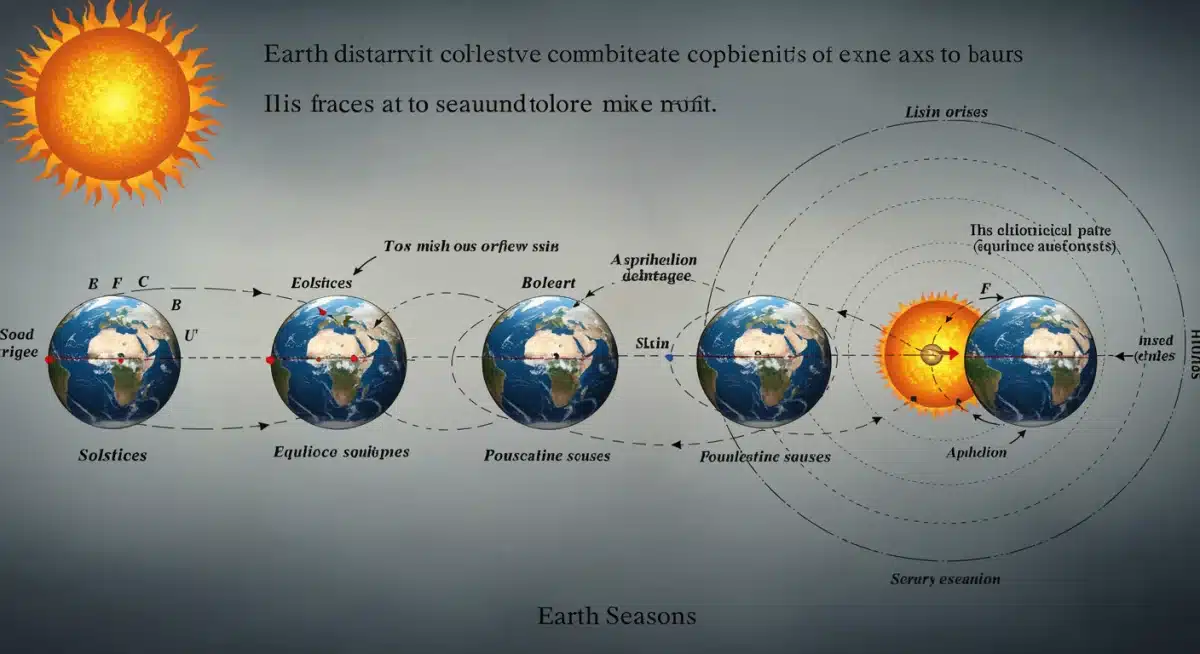
Consider the Northern Hemisphere: it experiences summer when Earth is near aphelion (farthest from the Sun) and winter when Earth is near perihelion (closest to the Sun). This fact alone clearly demonstrates that distance is not the primary factor. However, the orbital distance does have a subtle modifying effect.
How Both Factors Influence Climate
- Axial Tilt’s Primary Role: The 23.5-degree tilt determines the directness of solar rays and the length of daylight hours, which are the main factors influencing seasonal temperatures and patterns.
- Orbital Distance’s Modifying Effect: While not causing the seasons, the varying distance from the Sun at perihelion and aphelion can slightly intensify or moderate them. For example, Northern Hemisphere winters are slightly milder because they occur when Earth is closer to the Sun, while Southern Hemisphere winters are slightly colder because they happen when Earth is farther away.
This subtle interaction means that while axial tilt dictates the onset and general character of seasons, the varying solar radiation due to perihelion and aphelion can subtly influence their severity. Understanding this distinction is key to truly grasping the complex mechanisms that shape our planet’s climate and weather patterns.
Subtle Effects on Earth’s Climate and Weather Patterns
While Earth’s axial tilt is the dominant force behind our seasons, the varying distance from the Sun at perihelion and aphelion does exert subtle, yet scientifically measurable, influences on global climate and weather patterns. These effects are not immediately obvious in daily forecasts but contribute to the broader climatic trends and atmospheric dynamics that scientists study.
The 7% difference in solar radiation received between perihelion and aphelion is absorbed by Earth’s atmosphere, oceans, and landmasses. This additional energy at perihelion, even if not directly causing warmer seasons, can slightly increase global average temperatures and influence atmospheric circulation patterns. Conversely, at aphelion, the reduced solar input can lead to a slight cooling effect.
These subtle changes in solar energy can impact various atmospheric phenomena, including wind patterns, cloud formation, and precipitation distribution. For instance, stronger solar radiation at perihelion might slightly enhance the energy available for tropical cyclones or influence the intensity of monsoons in certain regions. However, these are complex interactions, often masked by more immediate weather systems and other climatic drivers.
Impacts on Atmospheric and Oceanic Systems
The oceans, with their vast thermal capacity, play a significant role in moderating these orbital effects. They absorb and redistribute heat over long periods, dampening the immediate impact of varying solar insolation. However, long-term studies suggest that the cumulative effect of perihelion and aphelion can contribute to ocean temperature fluctuations and sea-level variability over geological timescales.
Furthermore, the timing of perihelion and aphelion relative to the solstices and equinoxes is not fixed. Over thousands of years, these timings shift, leading to what are known as Milankovitch cycles. These long-term orbital variations are believed to be major drivers of Earth’s ice ages and interglacial periods, demonstrating that while the annual effects are subtle, their cumulative impact over vast stretches of time is profound.
In essence, the 2026 perihelion and aphelion, like their annual predecessors and successors, serve as reminders that Earth’s climate is a delicate balance influenced by a multitude of factors, from the tilt of its axis to its precise distance from the Sun at any given moment.
Long-Term Orbital Variations: Milankovitch Cycles
Beyond the annual perihelion and aphelion, Earth’s orbit is subject to much longer-term variations, collectively known as Milankovitch cycles. These cycles, named after Serbian astrophysicist Milutin Milanković, describe how changes in Earth’s orbital eccentricity, axial tilt (obliquity), and axial precession influence the amount and distribution of solar radiation received by our planet. These are not just academic curiosities; they are considered fundamental drivers of Earth’s past ice ages and interglacial periods.
The three primary Milankovitch cycles operate on vastly different timescales, ranging from tens of thousands to hundreds of thousands of years. Each cycle independently affects the amount of solar energy reaching Earth, and their combined effect can lead to significant climatic shifts over geological time. Understanding these cycles is crucial for interpreting past climate records and for modeling future climate scenarios, particularly in the context of natural climate variability.
The Three Key Milankovitch Cycles
- Eccentricity (100,000-year cycle): This refers to the shape of Earth’s orbit, which varies from nearly circular to more elliptical. A more eccentric orbit exaggerates the difference in solar radiation received at perihelion and aphelion, potentially leading to more extreme seasonal differences.
- Obliquity (Axial Tilt) (41,000-year cycle): This is the variation in the tilt of Earth’s axis, ranging from about 22.1 to 24.5 degrees. A greater tilt leads to more extreme seasons (hotter summers, colder winters), while a smaller tilt results in milder seasons.
- Precession (23,000-year cycle): This is the wobble of Earth’s axis, similar to a spinning top. Precession changes the timing of perihelion and aphelion relative to the solstices and equinoxes, affecting which hemisphere experiences summer when Earth is closest to the Sun.
The interplay of these cycles is complex. For example, when Earth’s orbit is highly eccentric, and perihelion occurs during summer in one hemisphere, that hemisphere will experience particularly warm summers. Conversely, if it occurs during winter, winters will be milder. These long-term orbital variations, though not directly observable in the 2026 perihelion and aphelion, provide the grand astronomical context within which our annual orbital events take place.
Studying Milankovitch cycles helps scientists understand natural climate fluctuations and differentiate them from more recent, human-induced climate change, providing a critical baseline for environmental research.
Observing Earth’s Orbital Dance from the Ground
While the perihelion and aphelion are specific points in Earth’s orbit, their direct observation from the ground isn’t as straightforward as watching a lunar eclipse or a meteor shower. We don’t visibly ‘see’ Earth getting closer or farther from the Sun in real-time. However, the effects of this orbital dance can be appreciated indirectly through various scientific observations and a deeper understanding of astronomy.
For astronomers and citizen scientists alike, tracking these orbital events involves understanding the precise ephemerides—the calculated positions of celestial objects over time. These calculations are based on fundamental laws of physics and extensive observational data, allowing us to pinpoint the exact moments of perihelion and aphelion. While we can’t feel the Earth moving faster or slower in its orbit, the cumulative knowledge of these movements enriches our appreciation of cosmic mechanics.
Specialized instruments and long-term climate data analysis are how scientists ‘observe’ the subtle impacts of these orbital variations. For the everyday observer, it’s more about understanding the underlying principles that govern our planet’s journey and how they contribute to the broader picture of Earth’s environment.
Ways to Appreciate Orbital Mechanics
- Astronomical Software: Many planetarium programs and apps allow users to visualize Earth’s orbit, including the perihelion and aphelion points, and understand their timing.
- Solar Radiation Monitoring: Scientists use satellites and ground-based sensors to continuously monitor solar radiation levels, which subtly fluctuate with Earth’s orbital distance.
- Climate Data Analysis: Long-term climate records, when meticulously analyzed, can reveal patterns that correlate with orbital variations, albeit often overshadowed by other climatic factors.
The beauty of Earth’s orbital dance lies in its predictability and its profound implications. Even without direct visual confirmation, the knowledge that our planet is constantly moving, shifting its distance from the life-giving Sun, adds a layer of wonder to our existence. The 2026 perihelion and aphelion are just two moments in this eternal cosmic ballet, offering a chance to reflect on the intricate forces that shape our world.
Engaging with these concepts helps foster a deeper connection to the cosmos and reinforces the idea that everything on Earth is interconnected with its celestial environment.
Future Projections and Ongoing Research
The study of Earth’s orbital variations, including the annual perihelion and aphelion and the longer Milankovitch cycles, is an active and evolving field of research. Scientists continuously refine their models and gather new data to better understand the complex interplay between celestial mechanics and terrestrial climate. These efforts are crucial for improving our climate predictions and understanding Earth’s past and future environmental states.
Future projections regarding perihelion and aphelion focus less on their exact dates, which are highly predictable, and more on the long-term trends of Earth’s orbital eccentricity, obliquity, and precession. These long-term changes can have significant implications for global climate over thousands to hundreds of thousands of years. For instance, understanding when a period of low eccentricity might coincide with a specific axial tilt can help predict future ice age cycles.
Ongoing research utilizes advanced satellite technology, paleoclimate data (from ice cores, tree rings, and sediment layers), and sophisticated climate models to piece together a comprehensive picture. These models help scientists simulate how changes in solar insolation due to orbital variations might interact with other climate forcings, such as greenhouse gas concentrations, to shape Earth’s climate.
Key Areas of Research
- Paleoclimate Reconstruction: Scientists analyze geological records to reconstruct past climates and identify the fingerprints of Milankovitch cycles, helping to validate orbital forcing theories.
- Orbital Parameter Refinement: Continuous astronomical observations and gravitational modeling improve the precision with which we can predict future orbital parameters.
- Climate Model Integration: Incorporating orbital variations into global climate models helps assess their relative importance compared to other climate drivers, especially for long-term climate projections.
The 2026 perihelion and aphelion, while annual occurrences, contribute to this broader scientific endeavor. Each year provides another data point, another opportunity to observe and confirm the intricate dance of our planet around the Sun. The knowledge gained from this ongoing research not only deepens our understanding of fundamental astronomical principles but also provides critical insights into the natural cycles that have shaped, and will continue to shape, our planet’s environment.
This commitment to research ensures that our understanding of Earth’s orbital variations remains at the forefront of scientific discovery, continually informing our perspective on cosmic events and their profound terrestrial impacts.
| Key Point | Brief Description |
|---|---|
| Perihelion 2026 | Earth’s closest approach to the Sun, expected early January, increasing solar radiation. |
| Aphelion 2026 | Earth’s farthest point from the Sun, expected early July, decreasing solar radiation. |
| Axial Tilt | Primary cause of seasons, not orbital distance, dictating directness of sunlight. |
| Milankovitch Cycles | Long-term orbital variations influencing Earth’s climate over thousands of years. |
Frequently Asked Questions About Earth’s Orbit
Perihelion is the point in Earth’s elliptical orbit when it is closest to the Sun, while aphelion is when it is farthest. These events occur annually, typically in early January and early July, respectively, influencing the amount of solar radiation Earth receives.
No, Earth’s axial tilt is the primary cause of the seasons. While orbital distance does slightly modulate the intensity of seasons, the tilt dictates which hemisphere receives more direct sunlight, leading to summer or winter.
There is approximately a 7% difference in solar radiation received. Earth gets about 7% more solar energy at perihelion than at aphelion, which can subtly influence global temperatures and atmospheric dynamics.
Milankovitch cycles are long-term variations in Earth’s orbital eccentricity, axial tilt, and precession. These cycles influence the distribution of solar radiation over thousands of years and are considered major drivers of ice ages.
We cannot directly ‘see’ these events. Their occurrence is determined by astronomical calculations. However, their subtle effects on solar radiation and climate are measured and studied through scientific instruments and long-term data analysis.
Conclusion
The 2026 perihelion and aphelion are more than just annual astronomical occurrences; they are integral components of Earth’s intricate orbital journey around the Sun. While the planet’s axial tilt remains the primary determinant of our seasons, the varying distances at perihelion and aphelion introduce subtle yet significant modulations to the amount of solar radiation received. These variations, though often imperceptible in our daily lives, contribute to the complex tapestry of global climate and weather patterns, and over geological timescales, they play a profound role in shaping Earth’s long-term climatic history through Milankovitch cycles. Continued research into these orbital dynamics enhances our understanding of our planet’s past, present, and future, underscoring the deep connection between celestial mechanics and terrestrial life.