Unlocking Your Natal Chart: A 7-Step Guide for 2026

Understanding your natal chart in 2026 involves decoding planetary positions, houses, and aspects at your birth to reveal your unique personality, strengths, challenges, and life purpose, offering a profound tool for self-awareness and growth.
Have you ever wondered what makes you, uniquely you? In 2026, the ancient wisdom of astrology offers a profound tool for self-discovery: your natal chart. This comprehensive guide will walk you through Unlocking Your Natal Chart: A 7-Step Guide to Understanding Your Unique Astrological Blueprint in 2026, providing clarity on your inherent talents, challenges, and life’s purpose.
Step 1: Obtain Your Natal Chart and Understand Basic Elements
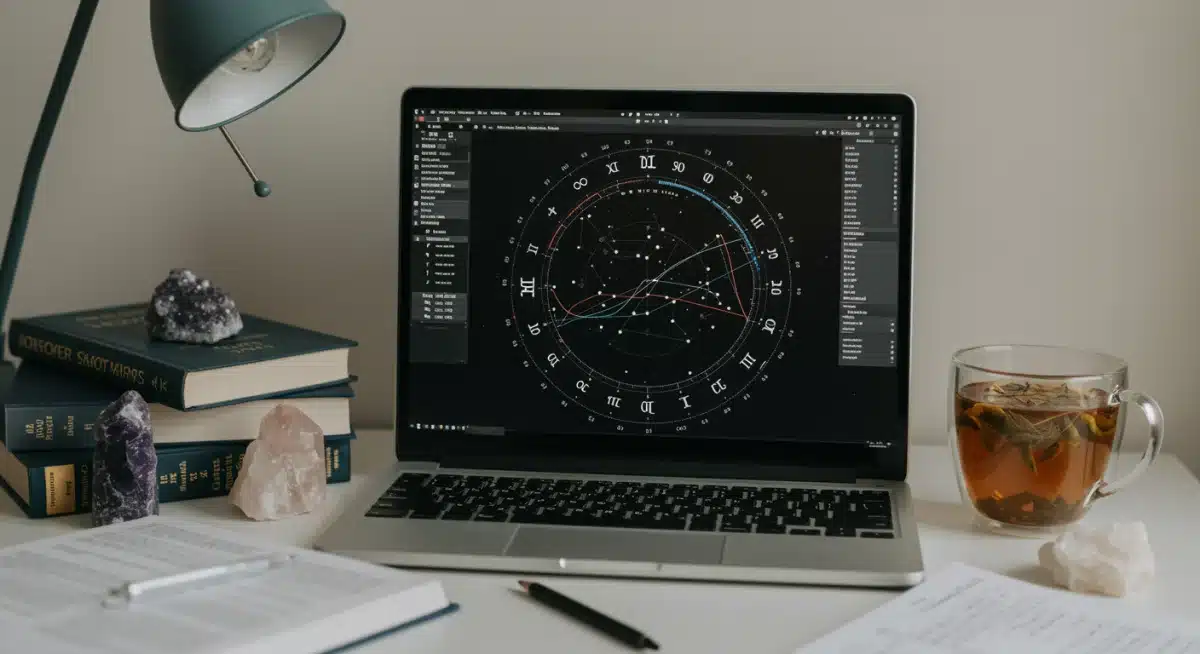
The journey to understanding your unique astrological blueprint begins with obtaining your natal chart. This cosmic snapshot captures the exact positions of the planets, houses, and zodiac signs at the precise moment and location of your birth. With advancements in technology, generating an accurate natal chart is easier than ever, requiring only your birth date, time, and place.
Once you have your chart, you’ll notice a circular diagram filled with various symbols. These symbols represent the core components of astrology: the planets, the zodiac signs, and the twelve houses. Each element plays a crucial role in shaping your personality and life experiences. Familiarizing yourself with these basic elements is the foundational step to deeper interpretation.
The Significance of Birth Time and Place
Accuracy in your birth time and place is paramount. Even a few minutes’ difference can shift the ascendant (rising sign) and the house cusps, significantly altering the chart’s interpretation. If you don’t know your exact birth time, various astrological rectification techniques can help, though consulting an experienced astrologer is often recommended for precision.
- Birth Date: Determines the sun sign and planetary positions in signs.
- Birth Time: Crucial for calculating the ascendant and house placements.
- Birth Place: Essential for geographical coordinates, influencing house systems.
The initial step of securing an accurate chart cannot be overstated. It sets the stage for all subsequent analysis, ensuring that the insights you gain are truly reflective of your individual cosmic signature. Take your time with this preparatory phase, as it lays the groundwork for a truly rewarding journey of self-discovery.
Step 2: Decode the Planets and Their Archetypes
In astrology, the planets are not merely celestial bodies; they are archetypal energies representing different facets of your personality and life’s functions. Each planet governs specific drives, needs, and expressions. Understanding these planetary archetypes is key to deciphering their influence in your natal chart.
The Sun, Moon, and Ascendant are often considered the ‘Big Three’ due to their profound impact on your core identity, emotional nature, and outward personality. However, each of the ten planets (including Pluto as a significant astrological body) contributes a unique flavor to your overall psychological makeup.
Exploring Personal and Outer Planets
Planets are generally categorized into personal planets (Sun, Moon, Mercury, Venus, Mars) and outer planets (Jupiter, Saturn, Uranus, Neptune, Pluto). The personal planets reflect day-to-day experiences and conscious traits, while the outer planets symbolize generational themes, deeper psychological patterns, and unconscious urges.
- Sun: Your core essence, ego, and life purpose.
- Moon: Your emotional world, instincts, and subconscious needs.
- Mercury: Your communication style, intellect, and thought processes.
- Venus: Your approach to love, relationships, and values.
- Mars: Your drive, ambition, and how you assert yourself.
- Jupiter: Your growth, luck, and philosophical outlook.
- Saturn: Your discipline, challenges, and lessons learned.
- Uranus: Your individuality, innovation, and rebellious spirit.
- Neptune: Your spirituality, dreams, and illusions.
- Pluto: Your transformation, power dynamics, and unconscious forces.
By understanding what each planet symbolizes, you can begin to see how these energies manifest within you. Their placement in signs and houses further refines their expression, painting a detailed portrait of your inner workings and how you interact with the world.
Step 3: Interpret Zodiac Signs and Their Modalities
The twelve zodiac signs represent distinct energetic currents that color the expression of the planets. When a planet resides in a particular sign, it adopts the characteristics and qualities of that sign. For instance, Venus in Leo will express love differently than Venus in Cancer.
Beyond individual characteristics, zodiac signs are grouped by elements (Fire, Earth, Air, Water) and modalities (Cardinal, Fixed, Mutable). These groupings provide another layer of understanding, revealing fundamental approaches to life and interaction patterns.
Elemental and Modal Influences
The elements describe the fundamental nature of the energy: Fire signs are passionate and energetic; Earth signs are practical and grounded; Air signs are intellectual and communicative; Water signs are emotional and intuitive. The modalities, on the other hand, indicate how that energy is expressed:
- Cardinal Signs (Aries, Cancer, Libra, Capricorn): Initiators, leaders, and pioneers. They start things.
- Fixed Signs (Taurus, Leo, Scorpio, Aquarius): Stable, resolute, and resistant to change. They maintain things.
- Mutable Signs (Gemini, Virgo, Sagittarius, Pisces): Adaptable, flexible, and changeable. They adjust and complete things.
Analyzing the distribution of planets across these elements and modalities in your chart can highlight dominant tendencies or areas where balance might be needed. For example, a predominance of Fire signs suggests a dynamic and driven individual, while a lack of Earth signs might indicate challenges with practicality or grounding.
Each sign offers a unique lens through which planetary energies are filtered, providing depth and nuance to your natal chart interpretation. Understanding these basic principles allows you to move beyond simple sun sign astrology and appreciate the rich complexity of your cosmic identity.
Step 4: Explore the Twelve Astrological Houses
While planets represent ‘what’ and signs represent ‘how,’ the houses in astrology represent ‘where’ these energies manifest in your life. Each of the twelve houses corresponds to a specific area of experience, from personal identity and finances to relationships, career, and spirituality.
The houses begin with the Ascendant (first house cusp) and move counter-clockwise around the natal chart. The placement of planets within these houses, and the signs on their cusps, reveal where your planetary energies are most actively expressed and where significant life events are likely to occur.
The Domains of Life
Each house governs distinct life themes, providing a structured framework for understanding your life’s journey. For example, the 2nd house relates to personal possessions and values, while the 7th house governs partnerships and open enemies.
- 1st House (Ascendant): Self, identity, outward persona.
- 2nd House: Values, money, possessions, self-worth.
- 3rd House: Communication, siblings, short journeys, early education.
- 4th House (IC): Home, family, roots, emotional foundations.
- 5th House: Creativity, romance, children, pleasure.
- 6th House: Work, health, daily routines, service.
- 7th House (Descendant): Partnerships, marriage, open enemies.
- 8th House: Transformation, shared resources, intimacy, death, rebirth.
- 9th House: Higher education, philosophy, long journeys, spirituality.
- 10th House (MC): Career, public image, reputation, ambition.
- 11th House: Friends, groups, hopes, wishes, social causes.
- 12th House: Subconscious, hidden enemies, solitude, spirituality, self-undoing.
Understanding which houses contain planets, and which signs rule those houses, offers profound insights into the specific areas of your life where planetary energies are most active. This spatial dimension of the natal chart adds a practical context to the archetypal meanings of planets and signs.
Step 5: Analyze Aspects – The Planetary Relationships
Aspects are the angular relationships between planets in your natal chart. They reveal how the different energies within you interact and cooperate, or create tension and challenges. These relationships are crucial for a nuanced understanding of your personality and life dynamics.
Major aspects include conjunctions (0 degrees), oppositions (180 degrees), trines (120 degrees), squares (90 degrees), and sextiles (60 degrees). Each aspect carries a unique energetic signature, ranging from harmonious flow to dynamic tension.
Understanding Major Aspects
The interpretation of aspects is a significant part of natal chart analysis, as they describe the interplay between your different psychological functions. A square, for instance, might indicate an internal conflict that, when resolved, leads to significant growth, while a trine suggests areas of natural talent and ease.
- Conjunction (0°): Planets merge energies, intensifying their combined influence. Can be harmonious or challenging depending on the planets involved.
- Sextile (60°): Harmonious and supportive aspect, indicating opportunities and ease of expression between planetary energies.
- Square (90°): Challenging aspect creating tension and friction. It often highlights areas requiring effort and growth.
- Trine (120°): Highly harmonious and flowing aspect, indicating natural talents, ease, and good fortune in the areas represented by the planets.
- Opposition (180°): Creates tension and awareness of polarities. Often involves projecting one energy onto others, requiring balance and integration.
Learning to interpret aspects allows you to see the dynamic interplay between your planetary placements. It moves beyond static interpretations of individual planets and signs, revealing the complex, living tapestry of your unique astrological blueprint and how different parts of your psyche communicate.
Step 6: Integrate the Chart – Synthesizing Your Unique Blueprint
After breaking down the individual components of your natal chart—planets, signs, houses, and aspects—the next crucial step is to integrate all this information into a cohesive, meaningful narrative. This is where the art of chart interpretation truly comes into play, moving beyond individual definitions to understand the whole.
Integration involves looking for patterns, dominant themes, and recurring motifs within your chart. Does your chart emphasize a particular element or modality? Are there clusters of planets in certain houses? Are there repeated aspects involving specific planets?
Identifying Key Themes and Patterns
Synthesizing your chart means connecting the dots. For example, if you have Mars (action, drive) in Aries (initiator, fiery) in the 10th house (career, public image), and it forms a strong trine to Jupiter (expansion, luck) in Leo (creativity, leadership), this suggests a highly ambitious individual with a natural flair for leadership and the drive to pursue a prominent career.
- Dominant Elements/Modalities: Reveal your fundamental approach to life and energy.
- Hemisphere/Quadrant Emphasis: Indicate focus on self vs. others, past vs. future.
- T-Squares/Grand Trines: Highlight significant challenge areas or exceptional talents.
- Stelliums (planet clusters): Point to highly concentrated energy in specific life areas.
This holistic view helps you understand how different parts of your personality interact and influence each other. It allows you to see not just your strengths and weaknesses in isolation, but how they combine to create your unique self, offering a powerful tool for self-acceptance and personal development.
Step 7: Reflect, Journal, and Seek Professional Guidance
Understanding your natal chart is an ongoing process of reflection and application. Once you’ve grasped the fundamental interpretations, the next step is to actively engage with the insights gained. This involves personal reflection, journaling, and, if desired, seeking the wisdom of experienced astrologers.
Journaling about your planetary placements, sign characteristics, and house meanings can deepen your understanding. How do these astrological descriptions resonate with your lived experiences? Where do you see these energies manifesting in your daily life?
Continuous Learning and Application
Astrology is a language, and like any language, fluency comes with practice and immersion. Regularly revisiting your chart, especially during significant transits or life events, can provide new perspectives and reinforce your understanding. This continuous engagement transforms theoretical knowledge into practical wisdom.
- Personal Reflection: Meditate on how astrological insights align with your experiences.
- Journaling: Document your observations and feelings about your chart’s themes.
- Seek Professional Help: Consult experienced astrologers for deeper insights and guidance.
- Study Transits and Progressions: Understand how current planetary movements interact with your natal chart.
The journey of unlocking your natal chart is a powerful path to self-awareness. It’s a lifelong endeavor that continually reveals new layers of your unique astrological blueprint. Embrace this process with an open mind and allow the cosmos to guide you towards a deeper understanding of yourself and your place in the world.
| Key Step | Brief Description |
|---|---|
| Obtain Your Chart | Accurately generate your natal chart using birth date, time, and place. |
| Decode Planets | Understand the archetypal energies and functions of each planet. |
| Interpret Houses | Learn how planets and signs manifest in specific life areas. |
| Analyze Aspects | Discover the dynamic relationships and interactions between planets. |
Frequently Asked Questions About Natal Charts
A natal chart is a personalized map of the heavens at your exact birth moment. It’s crucial because it reveals your unique cosmic blueprint, detailing your personality, inherent talents, challenges, and potential life path, offering deep insights for self-understanding and personal growth.
Your birth time needs to be as accurate as possible, ideally down to the minute. Even small discrepancies can alter your ascendant (rising sign) and house cusps, significantly impacting the chart’s interpretation. Precision ensures the most accurate astrological insights.
No, your natal chart is a fixed snapshot of the sky at your birth and never changes. However, your understanding and interpretation of it can evolve as you grow and experience life. Astrologers use transits and progressions to see how current planetary movements interact with your unchanging natal chart.
If your exact birth time is unknown, you can use a general time (e.g., noon) for a basic chart, but the ascendant and house placements will be inaccurate. For better precision, consider astrological rectification, a process where an astrologer works backward from life events to determine a probable birth time.
Understanding your natal chart offers insights into your predispositions and potential, not a fixed destiny. It highlights your inherent strengths and challenges, empowering you to make conscious choices. It’s a tool for self-awareness, allowing you to exercise your free will more effectively and navigate life’s currents intentionally.
Conclusion
Embarking on the journey of Unlocking Your Natal Chart: A 7-Step Guide to Understanding Your Unique Astrological Blueprint in 2026 is a profound commitment to self-discovery and personal growth. By systematically exploring the planets, signs, houses, and aspects, you gain an unparalleled understanding of your inner workings and your destined path. This cosmic knowledge empowers you to navigate life’s challenges with greater wisdom, leverage your innate strengths, and ultimately live a more authentic and fulfilling life. Your natal chart is a dynamic guide, continually offering new insights as you evolve, making it an invaluable tool for anyone seeking deeper self-awareness in the modern world.