Mars Opposition 2025: 7 Crucial Viewing Windows
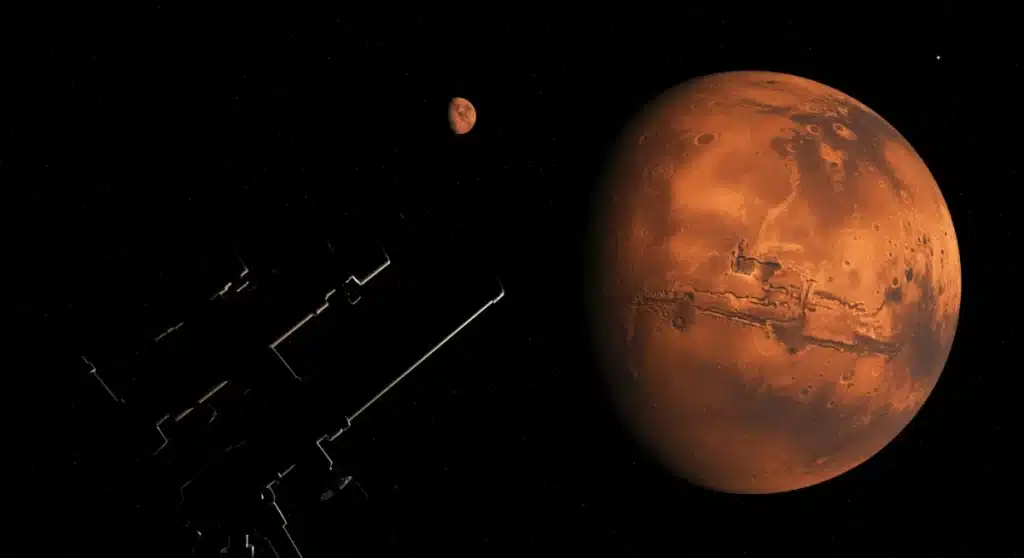
The Mars Opposition 2025 offers an unparalleled chance to observe the Red Planet in stunning detail, making it essential for enthusiasts to identify and capitalize on the specific viewing windows for optimal visibility.
Are you ready to witness a celestial spectacle unlike any other? The upcoming Mars Opposition 2025 promises an extraordinary opportunity for astronomers and casual skygazers alike to behold the Red Planet in its full glory, closer and brighter than usual. This guide will navigate you through seven crucial viewing windows to ensure you don’t miss a single moment of this cosmic event.
Understanding Mars Opposition: A Celestial Dance
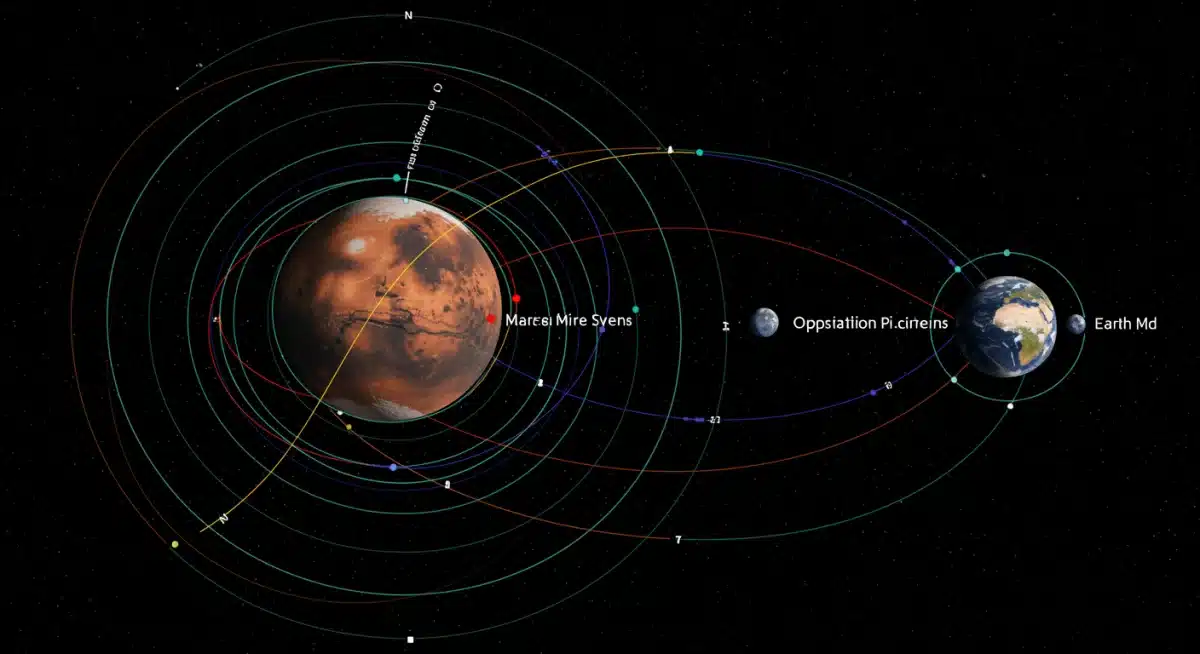
Mars opposition is a truly special astronomical alignment that occurs approximately every 26 months. It’s when Earth is positioned directly between the Sun and Mars, resulting in Mars being at its closest point to Earth and fully illuminated by the Sun, making it appear exceptionally bright and large in our night sky. This phenomenon provides an unparalleled chance for observation, allowing for clearer views of its surface features.
During opposition, Mars is visible for much of the night, rising around sunset, reaching its highest point in the sky around midnight, and setting around sunrise. This extended visibility window is a key advantage for observers, offering ample time to set up equipment and conduct thorough observations. The apparent size of Mars also increases significantly, making it an ideal target for both naked-eye viewing and telescopic exploration.
The 2025 opposition is particularly exciting as it promises excellent viewing conditions, contingent on atmospheric stability and a clear line of sight. Enthusiasts often plan their observational campaigns months in advance to make the most of these rare celestial alignments, securing the best possible views of our planetary neighbor.
The Science Behind Optimal Viewing Conditions
Achieving optimal viewing of Mars during an opposition involves more than just its proximity to Earth. Atmospheric conditions, light pollution, and even the planet’s own dust storms play significant roles. Understanding these factors can dramatically enhance your observational experience, transforming a good view into a truly unforgettable one.
One of the most critical elements is atmospheric seeing, which refers to the steadiness of Earth’s atmosphere. Turbulent air can blur telescopic images, much like looking through rippling water. Astrophotographers often use specialized cameras and software to capture thousands of short exposures, later stacking them to mitigate the effects of atmospheric distortion and reveal finer details on Mars’s surface.
Minimizing Light Pollution
Light pollution is another significant adversary for astronomers. The glow from urban areas can wash out fainter celestial objects and reduce the contrast of brighter ones like Mars. Traveling to darker skies, away from city lights, is often recommended to maximize visibility and appreciate the subtle nuances of the Red Planet.
- Identify dark sky locations using light pollution maps.
- Observe Mars when it is highest in the sky, minimizing atmospheric interference.
- Use light pollution filters on telescopes, though their effectiveness varies.
Impact of Martian Dust Storms
Mars is known for its global dust storms, which can obscure surface features for weeks or even months. While unpredictable, monitoring space weather reports and observations from professional observatories can provide valuable insights into the presence and severity of these storms. Observing before or after a major storm can yield the clearest views of the planet’s renowned geological formations.
Furthermore, the elevation of your observing site can influence seeing conditions, with higher altitudes often providing more stable air. However, accessibility and practical considerations usually limit this option for most amateur astronomers. Ultimately, a combination of planning, patience, and a bit of luck with the weather will determine the quality of your observations.
The 7 Crucial Viewing Windows for Mars Opposition 2025
To truly capitalize on the Mars Opposition 2025, it’s essential to pinpoint the specific periods offering the best observational opportunities. These windows are determined by a combination of Mars’s closest approach to Earth, its angular diameter, and its position relative to the Sun and our horizon. Each window offers unique advantages for different types of observers and equipment.
The primary opposition date is when Mars and the Sun are exactly 180 degrees apart in the sky, marking the moment of closest approach to Earth. However, the period around this date, extending several weeks before and after, also provides excellent viewing. We’ve identified seven key windows that maximize clarity and detail, allowing for both casual viewing and serious astrophotography.
Early Preparatory Window (Late December 2024 – Early January 2025)
While not yet at its absolute closest, this period allows observers to track Mars as it brightens and grows larger. It’s an ideal time for equipment calibration, familiarization with Mars’s position in the night sky, and practicing observational techniques. Early views can also provide a baseline for comparison as the opposition progresses.
- Practice identifying Mars among other celestial objects.
- Test different eyepieces and filters on your telescope.
- Familiarize yourself with Martian surface features using star charts.
Peak Brightness Window (Mid-January 2025)
This is when Mars reaches its maximum apparent magnitude, becoming incredibly luminous in the night sky. Even without a telescope, its reddish hue will be undeniable, and it will stand out significantly against the background stars. This window is perfect for public outreach events and encouraging new enthusiasts.
The planet’s closest approach to Earth will occur during this period, offering the largest apparent disk size. This is the prime time for high-resolution imaging and detailed visual observations of features like polar caps, dark albedo markings, and potential cloud formations. The increase in apparent size makes even modest telescopes capable of revealing impressive details.
Post-Opposition Clarity (Late January – Early February 2025)
Though Mars will slowly begin to recede, atmospheric conditions often stabilize after the initial peak excitement. This can lead to moments of exceptional atmospheric seeing, offering incredibly sharp views even as the planet’s apparent size slightly diminishes. Patience during this window can be highly rewarding for discerning observers.
Each of these windows offers a distinct advantage, whether for early preparation, peak observation, or capitalizing on stable atmospheric conditions. Planning your observations around these times will significantly increase your chances of a successful and memorable experience with the Red Planet.
Equipment for Enhanced Mars Observation
Observing Mars during opposition, especially the Mars Opposition 2025, can be a breathtaking experience, whether you’re using just your eyes or sophisticated astronomical gear. However, the right equipment can significantly enhance your views, revealing intricate details on the Red Planet’s surface. Choosing the appropriate tools depends on your budget, experience level, and observational goals.
For casual observers, a good pair of binoculars can already show Mars as a distinct disk, rather than just a point of light. Even 7×50 or 10×50 binoculars will offer a noticeable improvement over naked-eye viewing, making it easier to appreciate its reddish color and track its movement against the starry backdrop.
Telescopes: Your Gateway to Detail
To truly delve into Martian topography, a telescope is indispensable. Refractor telescopes, especially those with larger apertures, provide sharp, high-contrast images, ideal for planetary viewing. Reflectors, particularly Newtonian and Dobsonian designs, offer excellent light-gathering capabilities for their price, making them great for revealing fainter details.
- Refractors: Known for crisp images and minimal chromatic aberration.
- Reflectors: Excellent for light gathering and cost-effective for larger apertures.
- Catadioptric Telescopes (SCTs, Maksutovs): Compact, portable, and versatile, offering good performance for planetary observation.
Essential Accessories for Martian Viewing
Beyond the telescope itself, several accessories can elevate your observation. High-quality eyepieces are crucial for achieving optimal magnification and field of view. A Barlow lens can effectively double or triple your eyepiece’s magnification, allowing for closer views of Mars’s surface features without needing additional eyepieces.
Color filters are particularly useful for enhancing contrast on Mars. A red filter can bring out dark surface features, while a blue filter can highlight atmospheric phenomena like clouds or haze. A polarizing filter can reduce glare, especially useful when Mars is very bright. Lastly, a sturdy mount is vital for stable images, preventing frustrating vibrations that can blur your view.
Astrophotography Tips for Mars Opposition 2025
The Mars Opposition 2025 is a prime opportunity for astrophotographers to capture stunning images of the Red Planet. While challenging, capturing detailed images of Mars can be incredibly rewarding. Success hinges on a combination of proper equipment, meticulous technique, and a bit of patience with atmospheric conditions.
Unlike deep-sky objects, planetary imaging often involves capturing thousands of short video frames and then stacking them to overcome atmospheric turbulence. This technique, known as lucky imaging, allows software to select and combine only the sharpest frames, resulting in a much clearer final image than any single frame could provide.
Recommended Camera and Software
For planetary imaging, dedicated planetary cameras (often monochrome with color filters) or high-speed CMOS cameras are preferred over DSLR cameras. These cameras can capture video at high frame rates, which is essential for lucky imaging. Software like AutoStakkert!, Registax, and Photoshop are commonly used for stacking, wavelets processing, and final image enhancement.
- Planetary Cameras: High frame rates, low noise, often monochrome for filter use.
- Acquisition Software: FireCapture or SharpCap for recording video.
- Processing Software: AutoStakkert! for stacking, Registax for wavelets, Photoshop for final touches.
Mastering the Imaging Process
Begin by ensuring your telescope is perfectly collimated and your mount is accurately aligned. Use a high-power eyepiece to visually confirm Mars is sharp before attaching your camera. Focus is critical; use a Bahtinov mask or a similar focusing aid to achieve pinpoint sharpness. Record several short video clips, typically 60-120 seconds each, to provide enough frames for stacking.
Post-processing is where the magic happens. After stacking, use wavelets in Registax to bring out subtle details on Mars’s surface. Experiment with different settings, as too much processing can introduce artifacts. Finally, use Photoshop or GIMP for color balancing, noise reduction, and sharpening to create your final masterpiece. Remember, practice makes perfect, and each opposition offers a new chance to refine your skills.
Historical Significance of Mars Oppositions
Mars oppositions have captivated humanity for millennia, playing a pivotal role in our understanding of the cosmos and inspiring countless scientific endeavors and cultural narratives. From ancient astrologers to modern space agencies, the periodic close approach of the Red Planet has always been a moment of intense focus and discovery, including the highly anticipated Mars Opposition 2025.
In antiquity, Mars, with its fiery red hue, was often associated with war and conflict, influencing astrological predictions and mythological tales. Its seemingly erratic motion across the night sky puzzled early astronomers, leading to complex geocentric models to explain its behavior. The intellectual challenge posed by Mars’s retrograde motion ultimately became a catalyst for revolutionary scientific thought.
Kepler’s Laws and Martian Orbits
The meticulous observations of Mars by Tycho Brahe and, subsequently, Johannes Kepler were instrumental in overturning the Ptolemaic system and establishing the heliocentric model of the solar system. Kepler’s analysis of Mars’s orbital data led to his three laws of planetary motion, fundamentally changing our understanding of planetary mechanics and paving the way for Isaac Newton’s law of universal gravitation.
- Brahe’s precise measurements provided the raw data.
- Kepler’s mathematical analysis revealed elliptical orbits.
- His laws laid the foundation for modern celestial mechanics.
Modern Exploration and Inspiration
In more recent history, Mars oppositions have been crucial for planning robotic missions. The reduced distance minimizes travel time and fuel requirements, making it an optimal launch window for probes like Viking, Pathfinder, and the Mars rovers. These missions have revolutionized our understanding of Mars, from its geology and climate to the potential for past or present life.
Culturally, Mars has continued to inspire, from H.G. Wells’s War of the Worlds to contemporary science fiction. Each opposition reignites public interest in space exploration and serves as a powerful reminder of our place in the vast universe. The 2025 opposition continues this legacy, offering a fresh opportunity for both scientific study and public engagement with our intriguing planetary neighbor.
Future Mars Oppositions Beyond 2025
While the Mars Opposition 2025 is undoubtedly a highlight for astronomers, the celestial dance of Earth and Mars continues, offering future opportunities for observation. Understanding the cycle of these oppositions allows for long-term planning and ensures that enthusiasts can anticipate and prepare for subsequent close encounters with the Red Planet. Each opposition presents slightly different viewing conditions due to the elliptical nature of planetary orbits.
Mars oppositions occur roughly every 26 months, but not all are equally favorable. The distance between Earth and Mars at opposition varies significantly. Perihelic oppositions, when Mars is near its perihelion (closest point to the Sun) simultaneously with opposition to Earth, are the most spectacular, as Mars is at its absolute closest to Earth. These typically happen every 15 to 17 years.
Anticipating Future Close Encounters
Following 2025, the next Mars opposition will occur in late 2027. While it may not be as close as the 2025 event, it will still offer excellent viewing opportunities. The pattern continues, with subsequent oppositions in 2029, 2031, and so forth. Each event provides a chance to observe changes on Mars’s surface, such as the growth and recession of its polar ice caps or the emergence of new dust storm activity.
- 2027 Opposition: Good viewing, but slightly farther than 2025.
- 2029 Opposition: Continues the cycle, offering consistent observation chances.
- Perihelic Oppositions: The most significant events for maximum proximity and brightness.
Long-Term Observational Goals
For dedicated observers and researchers, tracking Mars through multiple oppositions provides invaluable data. It allows for the study of long-term climate patterns, geological changes, and the dynamic nature of its atmosphere. These sustained observations contribute to our broader understanding of planetary evolution and the conditions necessary for life, both within our solar system and beyond.
Ultimately, every Mars opposition is a unique event, a fleeting moment when our planetary neighbor draws near, inviting us to look up and ponder the mysteries of the cosmos. Planning for future oppositions ensures that this fascination with the Red Planet will continue to inspire generations of skygazers and scientists alike.
| Key Aspect | Description |
|---|---|
| What is Opposition? | Earth is between Mars and the Sun, making Mars appear brightest and closest. |
| Optimal Viewing | Requires dark skies, stable atmosphere, and clear line of sight, away from light pollution. |
| Equipment Needed | Binoculars for casual viewing, telescopes for detailed observation, and filters for contrast. |
| Astrophotography | Utilize high-speed cameras and stacking software (lucky imaging) for sharp images. |
Frequently Asked Questions About Mars Opposition 2025
The precise date for the Mars Opposition 2025 is typically in January 2025. While the exact moment is fleeting, the period several weeks before and after this date offers excellent viewing conditions, with Mars appearing notably bright and large in the night sky.
No, you don’t absolutely need a telescope. During the Mars Opposition 2025, Mars will be bright enough to be easily visible to the naked eye as a prominent reddish star. However, a telescope or even binoculars will significantly enhance the view, allowing you to discern more details on its surface.
The best times are when Mars is highest in the sky, usually around midnight local time. This minimizes the amount of Earth’s atmosphere you’re looking through, leading to clearer, steadier views. Observing from a dark location away from city lights also greatly improves visibility.
While you can certainly try, capturing detailed images of Mars with a smartphone alone is challenging. You might get a bright red dot. For better results, consider attaching your smartphone to a telescope using an adapter, or use a dedicated astrophotography camera for truly stunning images.
Mars oppositions occur approximately every 26 months, or about every two years and two months. However, the distance between Earth and Mars at opposition varies due to their elliptical orbits, making some oppositions, like the Mars Opposition 2025, more favorable for viewing than others.
Conclusion
The Mars Opposition 2025 represents a truly exceptional opportunity for anyone with an interest in the cosmos. By understanding the science behind this celestial event, preparing with the right equipment, and targeting the crucial viewing windows, you can transform a simple night of stargazing into a profound encounter with our planetary neighbor. Whether you’re a seasoned astronomer or a curious newcomer, the Red Planet awaits, promising a spectacle of unparalleled beauty and scientific intrigue.