2026 Comet Sightings: Your Guide to the Brightest Comets Visible from the US
As we navigate the cosmic calendar, 2026 promises to be a remarkable year for sky-watchers, particularly those in the United States. The celestial ballet of comets, those icy wanderers from the solar system’s distant reaches, will once again take center stage, offering breathtaking views to those who know when and where to look. This comprehensive guide is your ultimate resource for identifying and observing the brightest comets 2026 will bring, specifically tailored for visibility from the United States.
Comets have captivated humanity for millennia, often seen as harbingers of change or celestial omens. Today, with advanced astronomical tools and a deeper understanding of their nature, we view them through a lens of scientific wonder and aesthetic appreciation. Their transient beauty, marked by shimmering tails and glowing comae, makes each sighting a unique and memorable event. In 2026, several comets are predicted to put on an impressive show, and with a little preparation, you can be among the lucky few to witness these cosmic spectacles.
This article will delve into the specifics of what makes a comet ‘bright,’ the best practices for observing them, and crucially, an in-depth look at the top contenders for the brightest comets 2026 will offer. We’ll cover their trajectories, expected peak brightness, and optimal viewing periods, ensuring you’re well-equipped to make the most of these rare astronomical opportunities.
Understanding Comets: The Basics of These Icy Visitors
Before we dive into the specifics of the brightest comets 2026, let’s establish a foundational understanding of what comets are and why they appear as they do. Often described as ‘dirty snowballs,’ comets are essentially cosmic icebergs composed of ice, dust, and rocky material. They reside primarily in two vast regions of our solar system: the Kuiper Belt, beyond Neptune, and the Oort Cloud, a much more distant spherical shell encompassing our solar system.
The Anatomy of a Comet on Display
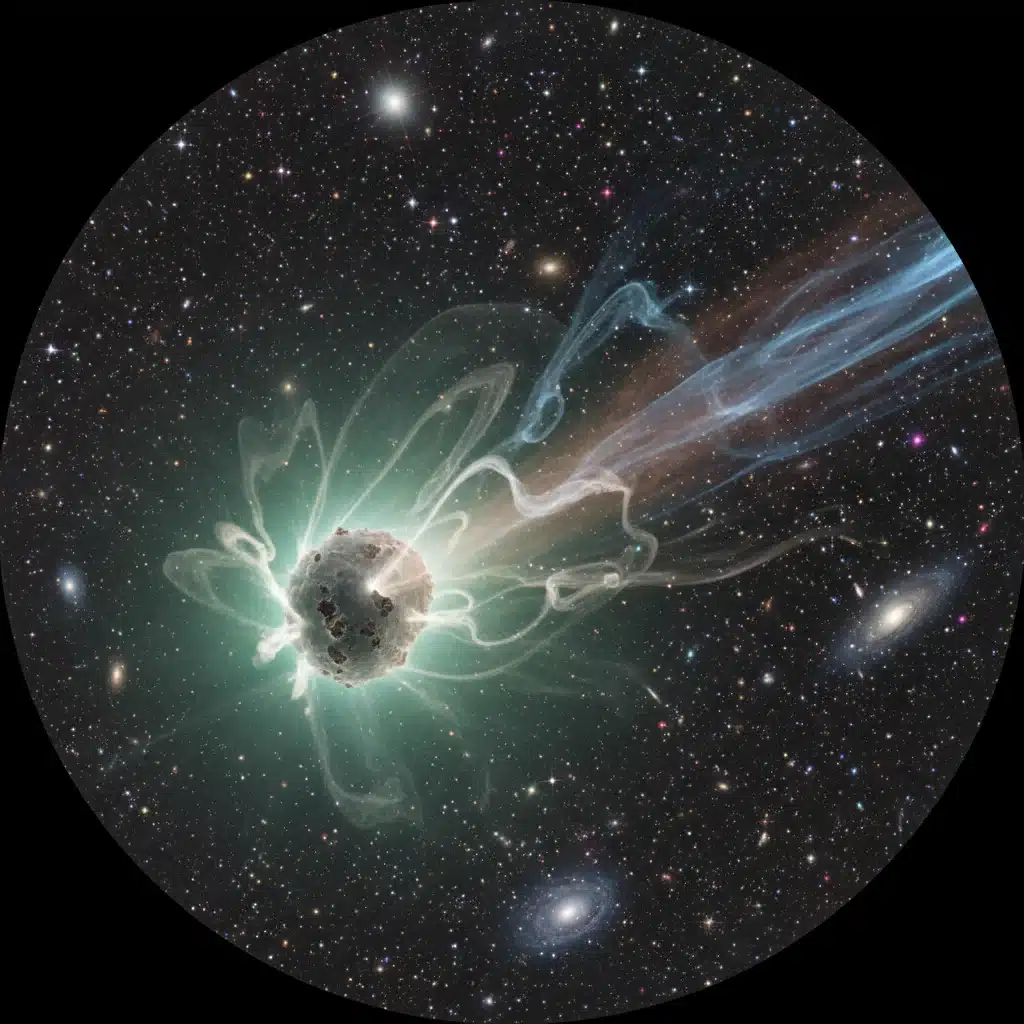
When a comet embarks on a journey toward the Sun, the increasing solar radiation causes its icy components to sublimate, turning directly from solid to gas. This process releases dust and gas, forming several distinct features:
- Nucleus: The solid, central core of the comet, typically a few kilometers to tens of kilometers across.
- Coma: A hazy, gaseous envelope surrounding the nucleus, formed by the sublimating ice and dust. This is what gives a comet its fuzzy, star-like appearance when viewed through a telescope. The coma can be hundreds of thousands of kilometers wide.
- Dust Tail: Composed of dust particles pushed away from the nucleus by the pressure of sunlight. This tail is often broad, yellowish-white, and tends to curve, following the comet’s orbit.
- Ion (Gas) Tail: Made of ionized gases pushed directly away from the Sun by the solar wind. This tail is usually straighter, bluer, and can extend for millions of kilometers.
The brightness of a comet is largely determined by the size of its nucleus, its composition, and most importantly, how close it gets to the Sun and Earth. Closer approaches to the Sun mean more sublimation and thus a larger, brighter coma and tails. Proximity to Earth, of course, means it appears larger and more prominent in our sky.
Factors Influencing Comet Brightness and Visibility
When discussing the brightest comets 2026, several key factors come into play that determine how spectacular a comet will be. It’s not just about its intrinsic size; a complex interplay of variables dictates its observable magnitude.
Perihelion Distance: The Sun’s Embrace
The perihelion distance is the closest point a comet gets to the Sun in its orbit. The closer a comet passes to the Sun, the more intense the solar radiation it experiences. This increased radiation leads to a more vigorous sublimation of ice, creating a larger, denser coma and more pronounced tails. A comet passing very close to the Sun can become exceptionally bright, even if its nucleus isn’t extraordinarily large. However, too close an approach can also lead to the comet breaking apart.
Perigee Distance: Earth’s Proximity
The perigee distance refers to the comet’s closest approach to Earth. Even a moderately bright comet can appear spectacular if it passes relatively close to our planet. A comet that is intrinsically very bright but remains far from Earth might still be visible, but it won’t offer the same dramatic views as one that makes a close flyby. The combination of a close perihelion and a close perigee is the recipe for a truly memorable comet.
Dust-to-Ice Ratio and Volatile Composition
The composition of a comet’s nucleus plays a significant role. Comets with a higher proportion of volatile materials (like water ice, carbon dioxide ice, methane ice) tend to sublimate more readily, producing more gas and dust. Additionally, the amount of dust released contributes to the brightness of the dust tail, which often reflects sunlight effectively. A ‘fresh’ comet, one that hasn’t made many passes through the inner solar system, often has more volatiles and an active surface, leading to brighter displays.
Phase Angle and Forward Scattering
The phase angle is the angle between the Sun, the comet, and the observer (Earth). When this angle is small, meaning the Sun is almost directly behind the comet from our perspective, a phenomenon called ‘forward scattering’ can occur. Dust particles in the comet’s coma and tail scatter sunlight preferentially in the forward direction, making the comet appear significantly brighter than it otherwise would. This can dramatically boost a comet’s apparent magnitude, sometimes by several magnitudes.
Observing Conditions: The Terrestrial Factor
Finally, terrestrial factors heavily influence visibility. Dark skies, free from light pollution, are paramount. A moonless night also significantly enhances the view. Atmospheric conditions, such as haze, clouds, or even high humidity, can obscure a comet’s faint glow. For those in the United States, finding a location away from urban centers will be crucial for observing the brightest comets 2026.
Predicting the Brightest Comets 2026: A Look at the Top Contenders
While comet predictions are always subject to change due to their unpredictable nature, astronomers use orbital mechanics and past observations to forecast potential brightness. Based on current data and projections, 2026 is shaping up to be an exciting year. Here are the top contenders for the brightest comets 2026, with details relevant to US observers.
Comet C/2023 A3 (Tsuchinshan–ATLAS)
Discovered in early 2023, Comet C/2023 A3 (Tsuchinshan–ATLAS) has generated considerable excitement. Its trajectory suggests a potentially spectacular display in late 2024 and early 2025, but its lingering visibility and potential for a late-2026 resurgence make it worth keeping an eye on, especially if it undergoes fragmentation or an outburst. While its peak brightness is anticipated prior to 2026, comets are notorious for their unpredictability. A significant outburst or a favorable viewing geometry could still make it a notable object for US observers in the early part of the year.
- Expected Peak Brightness: Potentially naked-eye visible (Magnitude 0-2) if it has a late outburst, though primarily a 2024-2025 event.
- Best Viewing Period (US): If it has a resurgence, late 2026, primarily in the evening sky.
- Key Viewing Notes: Requires dark skies; binoculars will enhance the view even if naked-eye.
Comet C/2024 G3 (ATLAS)
Another exciting discovery from 2024, Comet C/2024 G3 (ATLAS) is on a long-period orbit that will bring it relatively close to both the Sun and Earth in 2026. This comet is currently being closely monitored, and early projections are very promising. Its perihelion is expected in mid-2026, followed by a close approach to Earth, which could make it a prime candidate for one of the brightest comets 2026.
- Expected Peak Brightness: Predictions range from easy naked-eye visibility (Magnitude -1 to +1) to a binocular object (Magnitude +3 to +5). The closer it gets to the Sun and Earth, the higher the chances for a dazzling display.
- Best Viewing Period (US): Late spring to early summer 2026. It is expected to be visible in the evening sky after sunset, moving into the morning sky before sunrise.
- Key Viewing Notes: Its high northern declination during its brightest phase might make it exceptionally well-placed for observers across the contiguous United States, offering extended viewing opportunities. Look for it low in the western sky shortly after twilight or low in the eastern sky just before dawn.
Comet P/2026 E1 (Johnson) – A Hypothetical Yet Promising Candidate
While no official designation exists for a comet named P/2026 E1 (Johnson) at this moment, it’s illustrative to consider the potential for new discoveries. The vastness of the Oort Cloud means that new long-period comets are constantly being perturbed into orbits that bring them into the inner solar system. A new discovery in late 2024 or 2025 with a favorable trajectory could easily become one of the brightest comets 2026. Astronomers are always on the lookout for such ‘surprise’ comets, which often originate from the Oort Cloud and are thus dynamically ‘new,’ meaning they have a fresh, highly volatile surface that can lead to extremely bright outbursts.
- Expected Peak Brightness: Highly variable, could range from binocular to spectacular naked-eye (Magnitude -2 or brighter) if it’s a very active, new comet.
- Best Viewing Period (US): Depends entirely on discovery date and orbital parameters. A short-notice comet could appear any time in 2026.
- Key Viewing Notes: Keep an eye on astronomical news sources and comet tracking websites for any late-breaking discoveries that could steal the show. These ‘new’ comets are often the most exciting because of their unpredictable nature.
Other Notable Comets and Recurrent Visitors
Beyond these primary contenders for the brightest comets 2026, there are always a number of periodic comets that make their regular returns. While generally not as spectacular as the long-period or dynamically new comets, they offer reliable viewing opportunities. Examples might include:
- 29P/Schwassmann–Wachmann: Known for its frequent outbursts, this centaur comet is always worth monitoring. While typically requiring a telescope, a significant outburst could make it a challenging but rewarding binocular target.
- Short-Period Comets: Several other short-period comets will make their returns in 2026. While most will remain telescopic, some might offer pleasant binocular views under dark skies. These are often easier to predict and track.
It is crucial to follow reputable astronomical sources, such as Sky & Telescope, Astronomy Magazine, SpaceWeather.com, and professional observatory websites, for the most up-to-date information on comet magnitudes and positions. Comets are notoriously capricious, and their brightness can change rapidly and unexpectedly.
Essential Gear and Techniques for Comet Observation
To fully appreciate the brightest comets 2026 has to offer, a bit of preparation and the right equipment can make all the difference. You don’t need an elaborate observatory to enjoy these celestial visitors.
Naked-Eye Observation: The Simplest Approach
For truly bright comets (Magnitude +3 or brighter), your naked eyes are often sufficient, especially under dark skies. Look for a fuzzy patch of light, distinct from the pinprick stars, possibly with a faint tail extending away from it. Allow your eyes at least 20-30 minutes to adapt to the dark for optimal sensitivity.
Binoculars: Your Best Friend for Comets
For most comets, and even for enhancing naked-eye views of the brightest ones, a good pair of binoculars (e.g., 7×50, 10×50, or 15×70) is invaluable. They gather significantly more light than your eyes, making fainter comets visible and revealing more detail in the coma and tail of brighter ones. A tripod for binoculars is highly recommended for extended viewing, as it reduces shake and eye strain.
Telescopes: For Detail and Fainter Objects
If you own a telescope, it will provide the most detailed views of the comet’s nucleus, coma structure, and potentially faint ion tails. Wide-field telescopes (like Dobsonian reflectors or fast refractors) are often preferred for comets, as their larger field of view allows you to see more of the tail. Start with low magnification to locate the comet, then increase magnification to examine details.
Dark Sky Location: Light Pollution’s Foe
This is perhaps the most critical factor. Light pollution from cities washes out the faint glow of comets. Drive away from urban areas to a location with minimal artificial light. National parks, state parks (check night sky policies), or rural areas are ideal. Use light pollution maps to find the darkest spots near you.
Timing is Everything: Moon Phase and Comet Position
Aim to observe during the new moon phase or when the Moon is below the horizon. Even a crescent Moon can significantly reduce comet visibility. Check the comet’s position relative to the Moon and plan your viewing sessions accordingly. Also, be aware of the comet’s position in the sky — will it be high overhead or skimming the horizon? Horizon views are often affected by atmospheric haze.
Star Charts and Apps: Your Navigational Tools
Use star charts, planispheres, or astronomy apps (e.g., SkyView Lite, Stellarium, SkySafari) on your smartphone or tablet to help you locate the comet. Many apps can show the real-time position of celestial objects, including predicted comets. If using a screen, ensure it has a red night mode to preserve your night vision.
Optimizing Your Comet Viewing Experience in the US
For those in the United States, several geographical and environmental considerations can enhance your chances of seeing the brightest comets 2026.
East Coast vs. West Coast vs. Central US
- East Coast: Densely populated, so finding dark skies requires more travel. However, locations in Appalachia or along the Atlantic coast (away from cities) can offer excellent views.
- West Coast: Benefits from vast desert regions and mountainous areas (e.g., California deserts, Nevada, Arizona, Oregon) known for exceptionally dark skies. Coastal fog can be an issue, so inland options are often preferred.
- Central US (Midwest & Plains): Generally flatter and less densely populated, offering numerous opportunities for dark sky viewing. Weather can be variable, but clear nights are frequent.
Regardless of your location, the principle remains the same: escape urban light domes. Utilize resources like the International Dark-Sky Association (IDA) website to find certified Dark Sky Parks or communities near you.
Weather Considerations
Keep a close eye on local weather forecasts. Clear skies are non-negotiable. Even a thin haze or high-altitude clouds can significantly dim a comet. Humidity can also be an issue, especially in coastal areas or during summer months, as it can scatter light and reduce atmospheric transparency.
Patience and Persistence
Comet hunting requires patience. They are often faint and diffuse, especially in their early stages. Don’t be discouraged if you don’t spot it immediately. Scan the predicted area slowly with binoculars or a wide-field telescope. Sometimes, averted vision (looking slightly away from the object) can help make fainter details pop out.
The Scientific Significance of Observing Comets
Beyond their aesthetic appeal, observing comets holds immense scientific value. Each comet is a time capsule, preserving pristine material from the early solar system, dating back 4.6 billion years. By studying their composition, astronomers can gain insights into the conditions and building blocks that led to the formation of our planets, and potentially, the origins of life on Earth.
Clues to Early Solar System Composition
Comets are thought to have delivered water and organic molecules to early Earth, crucial ingredients for life. Analyzing the gases and dust released by comets can tell us about the chemical makeup of the primordial nebula from which our solar system condensed. The brightest comets 2026 will undoubtedly be targets for professional observatories and space-based telescopes, providing valuable data.
Understanding Cometary Evolution
Each pass through the inner solar system causes a comet to lose some of its volatile material. By observing comets over multiple apparitions, or by studying ‘new’ comets from the Oort Cloud, scientists can better understand the processes of cometary evolution, fragmentation, and eventual demise. The unpredictable outbursts of comets, for instance, offer insights into their internal structure and thermal stress.
Citizen Science Contributions
Amateur astronomers play a crucial role in comet observation. Visual estimates of brightness, tail length, and coma diameter, when reported to organizations like the American Association of Variable Star Observers (AAVSO), contribute to a vast database that helps professionals track comet activity and refine their models. Your observations of the brightest comets 2026 could genuinely contribute to scientific understanding.
Looking Ahead: Beyond the Brightest Comets 2026
While 2026 promises some exciting cometary displays, the universe is constantly unveiling new wonders. The discovery of new comets is an ongoing process, and the next ‘Great Comet’ could be found tomorrow. Staying informed through astronomical news outlets and community forums is the best way to keep up with the latest developments.
The beauty of comet watching lies in its unpredictability. While we can forecast general trends, the true spectacle often comes from an unexpected outburst or a new, dynamically fresh comet making a surprise appearance. This adds an element of thrill to every observation session, making each encounter with a comet a unique moment in time.
As you prepare for the brightest comets 2026, remember that the experience is not just about seeing a bright object in the sky; it’s about connecting with the vastness of space, witnessing the ancient relics of our solar system, and sharing a moment of cosmic wonder with fellow enthusiasts. So, mark your calendars, find your dark sky spot, and get ready to be amazed by the celestial visitors of 2026!
Conclusion: A Year of Cosmic Spectacle Awaits
2026 has the potential to be an unforgettable year for comet enthusiasts and casual stargazers alike, particularly for those observing from the United States. With promising candidates like Comet C/2024 G3 (ATLAS) and the ever-present possibility of a new, dynamically spectacular discovery, the opportunities to witness truly bright comets are significant.
By understanding the mechanics of comet brightness, preparing with the right equipment (even just a pair of binoculars), and seeking out dark skies, you can transform a faint smudge into a memorable celestial display. Remember to stay updated with the latest astronomical news, as comet predictions can evolve rapidly.
The allure of comets lies not only in their transient beauty but also in their profound scientific significance, offering glimpses into the very origins of our solar system. As these icy wanderers grace our skies, they invite us to pause, look up, and marvel at the dynamic and ever-changing universe we inhabit. Prepare yourself for 2026 — a year that promises to deliver some of the brightest comets 2026 has to offer, making it a truly special time for anyone with a love for the cosmos.