Catching Comet Halley in 2061: Your Ultimate Viewing Guide
Halley’s Comet, a celestial marvel, will make its next appearance in 2061, demanding meticulous long-term planning for optimal viewing of this extraordinary cosmic event.
The return of Halley’s Comet in 2061 is more than just another astronomical event; it’s a generational milestone, a chance to witness history repeating itself in the vast canvas of our solar system. For many, this will be a once-in-a-lifetime opportunity to observe one of the most famous comets, making Catching Comet Halley in 2061: Long-Term Planning for a Once-in-a-Lifetime Cosmic Event an essential endeavor for aspiring astronomers and casual stargazers alike. Starting your preparations now, almost four decades out, might seem premature, but the unique nature of this cosmic visitor necessitates foresight and dedication to truly appreciate its splendor.
Understanding Halley’s Comet: A Brief History and Its Orbit
Before we delve into future planning, it’s crucial to grasp the significance of Halley’s Comet itself. This isn’t just any comet; it’s perhaps the most well-known periodic comet, visible to the naked eye and with a rich history of observations dating back millennia. Its regular return has captivated humanity, influencing culture, science, and even superstition.
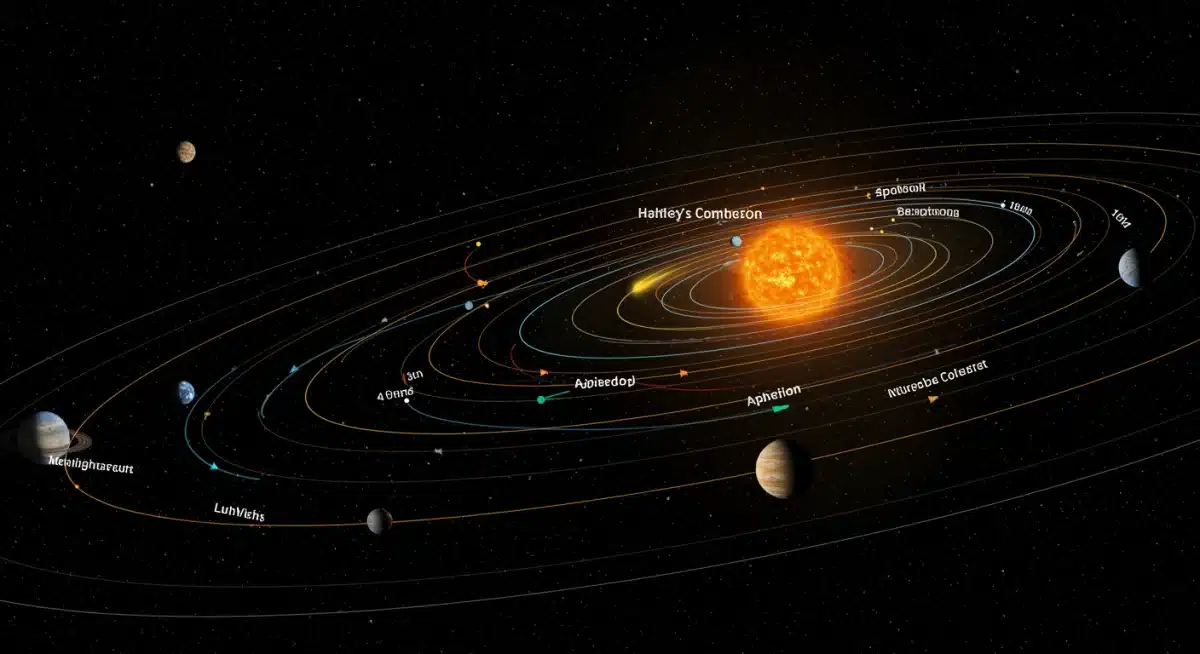
Edmond Halley, the English astronomer, was the first to realize that comets observed in 1531, 1607, and 1682 were in fact the same object. Using Newton’s laws of motion, he predicted its return in 1758, a prediction that, upon its fulfillment, cemented his legacy and gave the comet its enduring name. The comet’s orbit is a highly eccentric ellipse, taking it from within the orbit of Venus to beyond the orbit of Neptune, a journey that spans approximately 75 to 76 years.
The Comet’s Elliptical Path
Halley’s Comet follows a predictable, yet complex, elliptical path around the Sun. Its journey is a testament to the gravitational forces governing our solar system, offering a recurring spectacle for those on Earth. Understanding this orbit is key to predicting its visibility.
- Perihelion: The point in its orbit closest to the Sun, where it is brightest and most active.
- Aphelion: The farthest point from the Sun, where it is a dormant, icy body, far beyond naked-eye visibility.
- Orbital Period: Approximately 75-76 years, though gravitational perturbations from planets can slightly alter this.
The comet’s next perihelion passage is expected on July 28, 2061. This date is critical, as it marks the period of maximum brightness and activity, offering the best chance for observation. However, visibility from Earth depends on several factors beyond just perihelion.
Historically, Halley’s Comet has been observed and documented by various civilizations, from ancient China to medieval Europe. Each return has offered new insights into its composition and behavior. Its appearance in 1986, while somewhat underwhelming for many Northern Hemisphere observers due to poor geometry, still provided invaluable data from spacecraft missions. The upcoming 2061 return promises a much better viewing experience, especially for those in the Northern Hemisphere.
Predicting the 2061 Appearance: What to Expect
The 2061 return of Halley’s Comet is anticipated to be much more favorable for observers in the Northern Hemisphere than its 1986 apparition. This is primarily due to the relative positions of Earth and the comet at the time of its closest approach to the Sun. The geometry will allow for higher visibility and potentially a brighter display in our night sky.
Astronomers and orbital mechanics specialists have been refining predictions for decades, using sophisticated models to pinpoint the comet’s trajectory and brightness. While exact conditions can vary, the general outlook is positive. The comet is expected to be visible to the naked eye for several weeks around its perihelion, with binoculars and telescopes enhancing the experience significantly.
Key Dates and Optimal Viewing Windows
While July 28, 2061, marks the perihelion, the period of optimal visibility will span several weeks before and after this date. This window allows for flexibility in planning and increases the chances of clear skies. Early predictions suggest the comet will be most prominent in the morning sky during June and July 2061, transitioning to the evening sky in August and September.
- Pre-Perihelion: Early June to mid-July 2061, likely visible in the pre-dawn sky.
- Perihelion: July 28, 2061, the peak of its brightness and activity.
- Post-Perihelion: August to September 2061, moving into the evening sky.
The comet’s brightness is measured in magnitudes, with lower numbers indicating greater brightness. While precise magnitudes for 2061 are still projections, the expectation is for it to reach a magnitude that makes it easily discernible without optical aid from dark-sky locations. Urban light pollution, however, will always be a factor that diminishes visibility, emphasizing the need for careful site selection.
It’s important to remember that comets are inherently unpredictable. While models provide strong estimates, factors like the comet’s outgassing rate and fragmentation can influence its actual brightness. Nevertheless, the anticipation for 2061 is high, building on the knowledge gained from past observations and missions.
Choosing Your Viewing Location: Dark Skies are Key
The success of Catching Comet Halley in 2061: Long-Term Planning for a Once-in-a-Lifetime Cosmic Event hinges significantly on selecting the right viewing location. Light pollution is the ultimate enemy of astronomical observation. Even a bright comet can be washed out by the glow of city lights, making a dark-sky site an absolute necessity for the best experience.
Ideally, you’ll want to be as far away from urban centers as possible. National parks, remote wilderness areas, and designated dark-sky preserves offer the best conditions. These locations provide an unobstructed view of the night sky, free from artificial light interference. Planning for such a location almost four decades in advance allows for thorough research and potential travel arrangements.
Factors for an Optimal Viewing Site
Beyond just darkness, several other factors contribute to an ideal viewing location. Considering these early will ensure a comfortable and productive experience.
- Minimal Light Pollution: Prioritize locations rated as Bortle Scale Class 1-3.
- Clear Horizon: Avoid areas with tall buildings, mountains, or dense forests that obstruct your view.
- Accessibility: Ensure the location is safe and accessible, especially if traveling with family or equipment.
- Weather Patterns: Research historical weather data for your chosen time of year to anticipate clear nights.
Consider joining local astronomy clubs or online forums dedicated to comet viewing. These communities often share valuable insights on prime locations, local conditions, and group viewing events. Many organizations will likely begin planning expeditions to optimal viewing sites well in advance of 2061, offering a structured way to participate.
For those unable to travel to extremely dark sites, even a suburban backyard can offer a glimpse, especially with optical aid and if the comet is particularly bright. However, managing expectations is key. The truly breathtaking views will come from pristine dark skies, where the comet’s tail can stretch dramatically across the heavens.
Essential Equipment for Comet Observation
While Halley’s Comet is expected to be visible to the naked eye, the right equipment will dramatically enhance your viewing experience, allowing you to discern finer details of its coma and tail. Investing in quality optics is a long-term commitment that will serve you well for many other celestial observations beyond 2061.
For casual observers, a good pair of binoculars will make a significant difference. Look for models with large objective lenses (e.g., 10×50 or 15×70) that gather more light, providing brighter and clearer views. A tripod for binoculars is highly recommended to stabilize the image and prevent arm fatigue during extended viewing sessions.
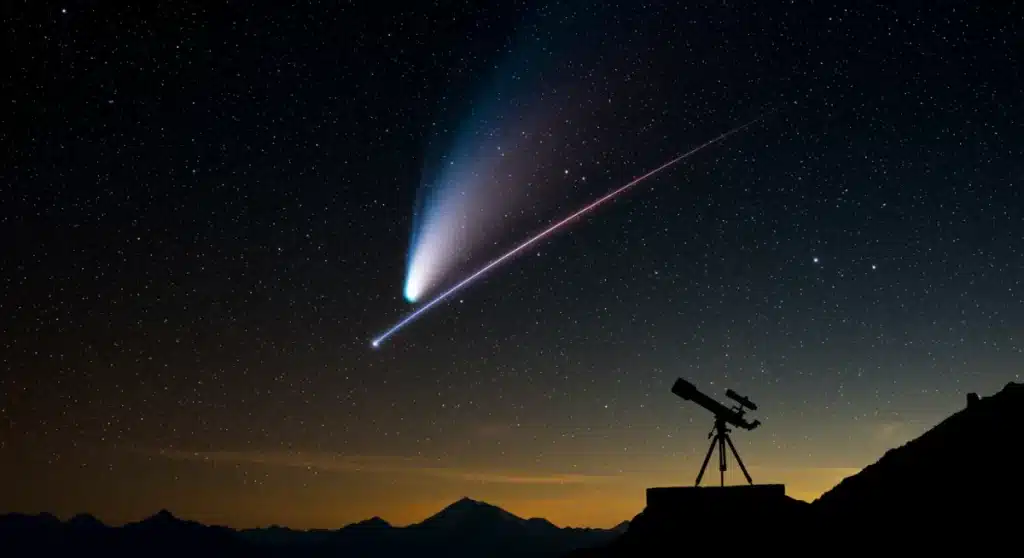
For serious enthusiasts, a telescope is the next step. Refractor telescopes (aperture 80mm-120mm) or Dobsonian reflector telescopes (aperture 6-10 inches) are excellent choices for comet viewing. They offer wider fields of view compared to many planetary telescopes, which is beneficial for capturing the comet’s expansive tail. Ensure your telescope has a sturdy mount for stability.
Recommended Optical Gear
- Binoculars: 10×50 or 15×70 for wide-field views.
- Telescope: Refractor (80mm-120mm) or Dobsonian (6-10 inch) for detailed observation.
- Tripod: Essential for stabilizing binoculars and small telescopes.
- Star Chart/App: To locate the comet’s position in the sky.
Beyond optics, consider accessories like red-light flashlights to preserve night vision, comfortable seating, and warm clothing, even in summer, as nights can get chilly. A planisphere or a stargazing app on your smartphone will be invaluable for navigating the night sky and pinpointing the comet’s exact location. Remember to familiarize yourself with your equipment well before 2061, practicing with other celestial objects to gain proficiency.
While the initial purchase of equipment might seem like a significant outlay, consider it an investment in a lifelong hobby. The thrill of observing a comet, especially one as legendary as Halley’s, with your own eyes through quality optics, is an unparalleled experience.
Navigating the Night Sky: Locating Halley’s Comet
Even with the best equipment and a perfect viewing location, finding Halley’s Comet in the vast expanse of the night sky requires some navigational skills. The comet, while bright, will still be a moving target, and its position relative to constellations will change over time. Early preparation involves familiarizing yourself with basic celestial navigation.
Star charts and astronomical software will be your best friends. These tools can predict the comet’s trajectory against the backdrop of fixed stars, allowing you to accurately point your binoculars or telescope. Many planetarium software programs already include Halley’s Comet’s 2061 trajectory, offering a virtual preview of what to expect.
Tools and Techniques for Comet Spotting
Developing a systematic approach to locating celestial objects will significantly improve your chances of a successful observation.
- Star Hopping: Use bright stars as guides to “hop” to the comet’s predicted location.
- Go-To Mounts: Telescopes with computerized “Go-To” mounts can automatically slew to the comet’s coordinates.
- Smartphone Apps: Many astronomy apps provide real-time sky maps and object locations.
- Patience: Allow your eyes to fully adapt to the dark (at least 20-30 minutes) before searching.
Learning to identify prominent constellations and asterisms will provide valuable reference points. For example, if the comet is predicted to pass near Orion, knowing how to find Orion will make your search much easier. Practice identifying other deep-sky objects and planets in the years leading up to 2061 to hone your skills.
Collaboration with other observers can also be beneficial. Attending star parties or joining guided viewing sessions organized by astronomy clubs can provide expert assistance in locating the comet. The shared excitement of a collective viewing experience also adds to the magic of the event.
Documenting Your Experience: Photography and Journaling
Observing Halley’s Comet in 2061 will be a deeply personal and memorable experience. Documenting it, whether through photography or journaling, allows you to preserve these memories and share them with others, potentially even future generations. Modern technology offers incredible opportunities for amateur astrophotography.
Even a smartphone, coupled with a telescope adapter, can capture surprisingly good images of bright celestial objects. For more serious photographers, a DSLR or mirrorless camera attached to a tracking mount and telescope will yield stunning results. Long-exposure photography is key to capturing the comet’s faint tail against the dark sky.
Methods for Preserving the Memory
Consider both visual and written documentation to create a comprehensive record of your observation.
- Astrophotography: Use a camera (smartphone, DSLR, mirrorless) with appropriate adapters and a tracking mount.
- Sketching: A traditional and rewarding way to capture what you see, focusing on details and impressions.
- Journaling: Record dates, times, viewing conditions, equipment used, and your personal reflections.
- Video: Capture short time-lapses of the comet’s apparent motion across the sky.
Beyond technical details, journaling about your feelings and impressions adds a unique human element to your documentation. What does it feel like to witness an object that has traversed the cosmos for millennia, seen by countless ancestors? These personal reflections are just as valuable as any photograph.
Remember to practice your astrophotography techniques on other comets or bright deep-sky objects in the years leading up to 2061. This will ensure you are proficient with your equipment and ready to capture the best possible images when Halley’s Comet makes its grand appearance. Sharing your documented experience online or with local astronomy groups can also contribute to a collective memory of this rare event.
The Legacy of Halley’s Comet: Inspiring Future Generations
The return of Halley’s Comet in 2061 is more than just an astronomical event; it’s an opportunity to inspire a new generation of scientists, astronomers, and curious minds. For many, witnessing such a rare cosmic spectacle can spark a lifelong passion for space exploration and scientific inquiry. Planning for this event is not just about personal enjoyment, but also about fostering a sense of wonder and encouraging educational outreach.
Schools, museums, and science centers will undoubtedly organize special programs and viewing events. Participating in or supporting these initiatives can help broaden the impact of the comet’s return. Imagine the excitement on a child’s face as they gaze upon Halley’s Comet, knowing they are seeing something their grandparents might have seen, and that their own grandchildren might also witness.
Engaging with the Next Generation
Consider how you can contribute to the educational legacy of Halley’s Comet’s return.
- Share Your Knowledge: Mentor younger enthusiasts or volunteer at local astronomy events.
- Community Outreach: Organize local viewing parties or educational talks.
- Educational Resources: Support initiatives that create learning materials about comets and space.
- Personal Stories: Share your own journey of planning and observation to inspire others.
The long lead time to 2061 provides ample opportunity to engage with younger audiences. Introduce them to basic astronomy, the history of Halley’s Comet, and the scientific principles behind its orbit. This extended period allows for a sustained educational effort, building anticipation and knowledge over years, not just months.
Ultimately, Catching Comet Halley in 2061: Long-Term Planning for a Once-in-a-Lifetime Cosmic Event is about more than just seeing a comet; it’s about connecting with the cosmos, with history, and with the future. It’s about recognizing our place in the grand scheme of the universe and fostering a shared human experience that transcends generations. Let this upcoming apparition be a moment of collective awe and scientific inspiration.
| Key Aspect | Brief Description |
|---|---|
| Viewing Window | Expected around July 28, 2061 (perihelion), with weeks of visibility before and after. |
| Optimal Location | Seek dark-sky sites (Bortle Scale 1-3) away from urban light pollution for best views. |
| Equipment Needed | Naked eye (from dark sites), binoculars (10×50/15×70), or a telescope for enhanced detail. |
| Planning Ahead | Research locations, practice navigation, and consider joining astronomy groups for collective planning. |
Frequently Asked Questions About Halley’s Comet 2061
Halley’s Comet is expected to be next visible from Earth around its perihelion on July 28, 2061. The period of naked-eye visibility will likely span several weeks before and after this date, offering ample opportunities for observation.
Yes, the 2061 apparition of Halley’s Comet is predicted to be significantly more favorable for observers in the Northern Hemisphere compared to 1986. The Earth’s position relative to the comet will allow for a much better view, potentially making it brighter and more prominent.
While potentially visible to the naked eye from dark locations, binoculars (10×50 or 15×70) or a small telescope (80mm-120mm refractor or 6-10 inch Dobsonian) will greatly enhance the view, revealing more detail in the comet’s tail and coma.
Given the rarity of the event, starting long-term planning now is advisable. This includes researching optimal viewing locations, considering equipment purchases, and familiarizing yourself with celestial navigation. Early preparation ensures the best possible experience.
The best viewing locations will be those with minimal light pollution, such as national parks, remote wilderness areas, or designated dark-sky preserves. Locations with clear, unobstructed horizons will also be crucial for an optimal observation experience.
Conclusion
The impending return of Halley’s Comet in 2061 represents a truly extraordinary opportunity, a cosmic rendezvous that transcends generations. While it may seem distant, the meticulous long-term planning for Catching Comet Halley in 2061: Long-Term Planning for a Once-in-a-Lifetime Cosmic Event is not just a practical exercise but an integral part of fully appreciating this rare spectacle. From understanding its historical significance and orbital mechanics to selecting prime dark-sky locations and preparing the right optical equipment, every step contributes to an unforgettable experience. This event offers a chance to connect with the universe on a profound level, to inspire curiosity, and to share a sense of wonder that will echo for decades to come. By starting our preparations today, we ensure that when Halley’s Comet graces our skies once more, we are ready to greet it with awe and scientific appreciation.