2025 Meditation Research: Brain Benefits Unpacked

The latest 2025 research confirms meditation profoundly reshapes brain structures, enhancing cognitive function, emotional regulation, and stress resilience through neuroplastic changes and optimized neural network activity.
Have you ever wondered what truly happens inside your brain when you meditate? Recent advancements in neuroscience are providing unprecedented insights. The year 2025 brings forth groundbreaking research that unequivocally solidifies the profound impact of meditation brain benefits, moving beyond anecdotal evidence to concrete scientific understanding.
The evolving landscape of meditation research in 2025
The scientific community’s understanding of meditation has undergone a significant transformation. What was once viewed with skepticism is now a robust field of inquiry, driven by advanced neuroimaging techniques and sophisticated analytical methods. The year 2025 marks a crucial point, as studies are not just confirming previous findings but also delving deeper into the mechanisms behind meditation’s efficacy.
Researchers are leveraging artificial intelligence and machine learning to analyze vast datasets of brain activity, revealing subtle yet powerful changes induced by various meditation practices. This allows for a more personalized approach to understanding how different techniques affect individuals, paving the way for tailored meditation protocols.
Advanced neuroimaging techniques and their revelations
Functional Magnetic Resonance Imaging (fMRI) and Electroencephalography (EEG) have been instrumental, but 2025 sees the rise of even more refined tools. Magnetoencephalography (MEG) offers superior temporal resolution, capturing the rapid neural oscillations associated with meditative states. Positron Emission Tomography (PET) scans are now more precise, allowing scientists to track neurotransmitter activity and receptor density changes in real-time, painting a vivid picture of the brain’s chemical response to meditation.
- High-resolution fMRI: Unveiling minute structural changes in gray matter.
- Real-time EEG feedback: Training individuals to achieve specific brainwave states.
- MEG for neural timing: Pinpointing the exact sequence of neural activation during focus.
- PET for neurochemistry: Mapping the release and reuptake of key neurotransmitters.
These technological leaps are providing granular detail on how meditation influences brain regions associated with attention, emotion regulation, and self-awareness. The collective evidence points towards a comprehensive remodeling of the brain’s architecture and function, leading to enhanced mental resilience and well-being.
Neuroplasticity: meditation’s power to reshape the brain
One of the most compelling aspects of meditation brain benefits highlighted in 2025 research is its profound effect on neuroplasticity. This is the brain’s remarkable ability to reorganize itself by forming new neural connections and strengthening existing ones. Meditation, particularly consistent long-term practice, has been shown to be a powerful catalyst for these structural and functional changes.
Studies are now isolating specific types of meditation and their unique impacts on different brain regions, moving beyond a one-size-fits-all understanding. For instance, mindfulness meditation appears to significantly bolster the prefrontal cortex, crucial for executive functions, while compassion meditation might more heavily influence areas related to empathy and social connection.
Gray matter volume and cortical thickness
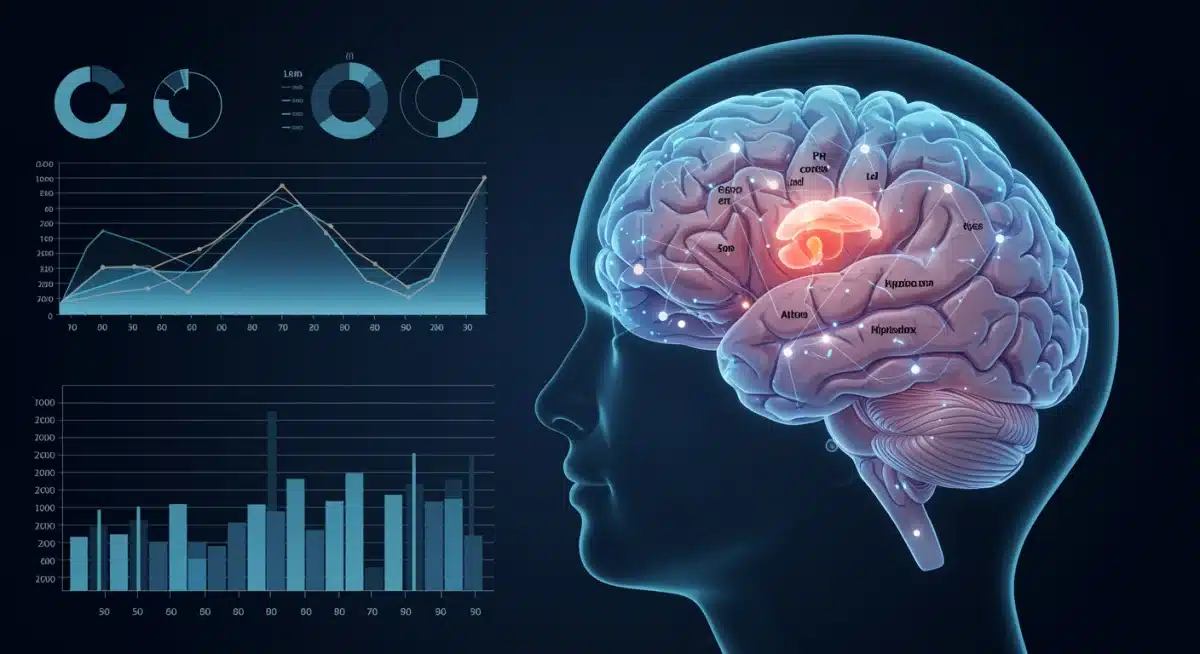
Longitudinal studies from 2025 consistently report increases in gray matter volume in meditators, particularly in areas like the hippocampus, primarily involved in memory and emotional regulation. Conversely, the amygdala, the brain’s fear center, often shows reduced gray matter density, correlating with decreased stress reactivity. Furthermore, cortical thickness, a measure of neuronal density, has been observed to increase in regions vital for attention and sensory processing.
- Hippocampal growth: Enhancing memory and emotional resilience.
- Amygdala reduction: Lowering anxiety and fear responses.
- Prefrontal cortex thickening: Improving decision-making and cognitive control.
- Insula activation: Heightening self-awareness and interoception.
These structural alterations are not merely cosmetic; they translate directly into tangible improvements in mental health and cognitive performance. The ability of meditation to sculpt the brain at such fundamental levels underscores its potential as a therapeutic intervention for a wide range of psychological conditions.
Enhancing cognitive functions through meditative practices
Beyond emotional regulation, the 2025 research firmly establishes meditation as a potent tool for cognitive enhancement. Specific meditation techniques have been linked to improvements in attention, working memory, and even creativity. This is particularly relevant in an increasingly demanding world where sustained focus and mental agility are highly valued.
The mechanisms behind these cognitive boosts are complex, involving changes in brainwave patterns, neurotransmitter systems, and the efficiency of neural networks. Researchers are now able to pinpoint which meditation practices are most effective for targeting particular cognitive domains, offering a more precise application of these techniques.
Attention and focus: the core of meditation’s cognitive impact
One of the most well-documented meditation brain benefits is its capacity to train and improve attention. Sustained attention, the ability to maintain focus on a single object or thought, and selective attention, the ability to filter out distractions, both show marked improvement in regular meditators. This is often attributed to strengthened connections in the default mode network (DMN), leading to less mind-wandering and greater presence.
Working memory, essential for daily tasks and problem-solving, also benefits. Studies indicate that meditation can increase the capacity and efficiency of working memory, allowing individuals to hold and manipulate more information in their minds. This has significant implications for academic and professional performance.
Boosting creativity and problem-solving skills
Emerging research from 2025 suggests that certain meditative states, particularly those associated with open monitoring practices, can foster divergent thinking and creativity. By reducing mental rigidity and opening the mind to novel connections, meditation may unlock new pathways for innovative thought and problem-solving. This is an exciting frontier, as it expands the perceived benefits of meditation beyond stress reduction into areas of pure cognitive enhancement.
The improvements in cognitive functions are not just about doing tasks faster or more efficiently; they’re about fostering a more adaptable and resilient mind, better equipped to navigate the complexities of modern life. These benefits underscore meditation’s role not just as a stress-reduction technique, but as a comprehensive mental training regimen.
Meditation’s impact on emotional regulation and stress reduction
Perhaps the most widely recognized benefit of meditation is its profound capacity to aid in emotional regulation and stress reduction. The 2025 research further refines our understanding of how meditation achieves this, showcasing intricate neural mechanisms that lead to greater emotional stability and a reduced physiological response to stressors. It’s not just about feeling calmer; it’s about fundamentally altering the brain’s stress circuitry.
The ability to observe thoughts and feelings without immediate reaction, a cornerstone of mindfulness, empowers individuals to choose their responses rather than being dictated by automatic emotional impulses. This cultivated detachment is a key factor in reducing reactivity to daily stressors and building emotional resilience.
Altering the brain’s stress response system
Meditation has been shown to modulate the hypothalamic-pituitary-adrenal (HPA) axis, the body’s central stress response system. Regular practice leads to lower levels of cortisol, the primary stress hormone, even in challenging situations. This physiological shift is coupled with changes in brain regions like the prefrontal cortex, which gains greater inhibitory control over the amygdala’s fear responses. The result is a calmer, more measured reaction to perceived threats.
- Reduced cortisol levels: Lowering physiological stress markers.
- Enhanced prefrontal-amygdala connectivity: Improving emotional control.
- Increased vagal tone: Promoting relaxation and parasympathetic activity.
- Greater emotional clarity: Distinguishing between thoughts and feelings.
These findings provide robust scientific backing for meditation’s role in managing anxiety, depression, and other stress-related disorders. The ability to actively downregulate the stress response and cultivate a more balanced emotional landscape is one of the most compelling meditation brain benefits.
The role of meditation in mental health and well-being in 2025
As we move deeper into 2025, the integration of meditation into mainstream mental healthcare is becoming increasingly prevalent. The scientific evidence is so compelling that healthcare providers are now more readily recommending mindfulness-based interventions for a variety of conditions, ranging from chronic pain to anxiety disorders. This shift signifies a growing recognition of meditation’s therapeutic potential.
Furthermore, preventative mental health strategies are emphasizing meditation as a core component. By fostering emotional resilience and cognitive agility, meditation acts as a buffer against the development of mental health issues, promoting overall well-being in a proactive manner.
Meditation as an adjunct therapy for various conditions
Research continues to demonstrate meditation’s effectiveness as an adjunct therapy for conditions such as depression, anxiety, PTSD, and even addiction. It helps individuals develop coping mechanisms, reduce rumination, and enhance self-awareness, which are critical components of recovery. The non-pharmacological nature of meditation makes it an attractive option for many seeking holistic approaches to mental health.
The personalized nature of intervention, guided by new research, allows for selecting specific meditation practices that best suit an individual’s needs and mental health profile. This precision medicine approach to mindfulness is a significant advancement.
Promoting overall psychological flourishing
Beyond treating illness, meditation is increasingly recognized for its role in promoting psychological flourishing and optimal human functioning. It helps individuals cultivate positive emotions, develop greater self-compassion, and foster a sense of purpose and connection. These elements contribute to a richer, more meaningful life, moving beyond mere absence of illness to a state of thriving.
The 2025 insights into meditation brain benefits suggest that its impact extends far beyond simple relaxation, offering a pathway to profound mental and emotional transformation, contributing significantly to a more resilient and compassionate society.
Future directions: personalized meditation and neurofeedback
The future of meditation research in 2025 is bright, with emerging trends pointing towards highly personalized interventions and advanced neurofeedback techniques. The goal is to move beyond generic meditation instructions to provide tailored practices that are optimized for individual brain profiles and specific desired outcomes. This level of customization promises to unlock even greater therapeutic potential.
Wearable technology and brain-computer interfaces are playing an increasingly important role, allowing individuals to receive real-time feedback on their brain states during meditation. This immediate feedback loop can significantly accelerate the learning process and deepen the meditative experience, making it more accessible and effective for a broader audience.
Tailoring meditation practices to individual brain signatures
Researchers are developing algorithms that can analyze an individual’s unique brain activity patterns and recommend specific meditation techniques that are most likely to yield desired results. For example, someone with an overactive amygdala might be guided towards compassion meditation, while someone struggling with focus might benefit more from a concentration-based practice. This level of personalization is a game-changer.
- AI-driven recommendations: Based on individual brain scans and psychological profiles.
- Genetic markers: Exploring how genetics influence meditation responsiveness.
- Personalized duration and frequency: Optimizing practice schedules for maximum benefit.
- Integration with mental health apps: Delivering customized meditation programs.
The ability to fine-tune meditation practices based on objective neurological data represents a significant leap forward in understanding and harnessing meditation brain benefits. It promises to make meditation an even more powerful and precise tool for mental and emotional well-being.
Integrating meditation into daily life for sustained benefits
While the scientific understanding of meditation brain benefits continues to advance, the practical application remains crucial: how can individuals effectively integrate these practices into their busy daily lives to achieve sustained positive effects? The 2025 research emphasizes that consistency, even in short bursts, is more important than infrequent, long sessions. Accessibility and adaptability are key.
The focus is shifting from rigid, lengthy meditation retreats to incorporating micro-meditations and mindful moments throughout the day. This approach makes meditation less intimidating and more sustainable, fitting seamlessly into the rhythm of modern living without requiring significant lifestyle overhauls.
Micro-meditations and mindful moments
Even a few minutes of mindful breathing or a body scan can activate beneficial neural pathways. Research suggests that these short, frequent practices can accumulate over time to produce significant structural and functional changes in the brain, similar to longer sessions. This makes meditation highly adaptable for professionals, parents, and anyone with a demanding schedule.
Integrating mindfulness into routine activities, such as eating, walking, or even doing chores, transforms mundane tasks into opportunities for mental training. This ubiquitous approach to mindfulness helps to extend the meditative state beyond formal practice, fostering a more present and aware state of being throughout the day.
Overcoming common barriers to consistent practice
Identifying and addressing common barriers to consistent meditation, such as lack of time, perceived difficulty, or skepticism, is a focus of current behavioral science. User-friendly apps, guided meditations, and community support groups are proving effective in helping individuals establish and maintain a regular practice. The goal is to make meditation an intuitive and enjoyable part of daily self-care, rather than a chore.
By making meditation more approachable and demonstrating its tangible, scientifically proven benefits, the goal is to empower more individuals to harness its transformative power for enhanced well-being and cognitive function in the long term.
| Key Benefit | Description (2025 Insights) |
|---|---|
| Neuroplasticity Enhancement | Meditation significantly increases gray matter in key brain regions like the hippocampus and prefrontal cortex, while reducing amygdala volume, leading to improved memory, emotional regulation, and decreased stress reactivity. |
| Cognitive Function Improvement | Advanced research confirms meditation boosts sustained and selective attention, enhances working memory capacity, and fosters divergent thinking for greater creativity and problem-solving abilities. |
| Emotional Regulation & Stress Reduction | Meditation modulates the HPA axis, lowering cortisol and strengthening prefrontal control over the amygdala, resulting in reduced stress, anxiety, and improved emotional stability. |
| Personalized Interventions | Future trends in 2025 involve AI-driven recommendations and neurofeedback, tailoring meditation practices to individual brain profiles for optimized and precise mental health outcomes. |
Frequently asked questions about meditation’s brain benefits
Meditation primarily impacts the prefrontal cortex (executive function), hippocampus (memory, emotion), amygdala (fear, stress), and insula (self-awareness). Research in 2025 shows increased gray matter in the former two and decreased activity or volume in the amygdala, leading to improved cognitive control and emotional balance.
While some subtle changes in brain activity can be observed after just a few weeks of consistent practice, significant structural changes, like increased gray matter, typically require several months to a year of regular meditation. Consistency is key for long-term neuroplastic effects.
Yes, 2025 research indicates different meditation types can emphasize distinct brain benefits. Mindfulness meditation often enhances attention and emotional regulation, while compassion meditation may boost empathy and social connection. Personalized approaches are emerging to match practices to desired outcomes.
Emerging evidence suggests that regular meditation practice may indeed help mitigate age-related cognitive decline. By maintaining gray matter volume, improving neural connectivity, and reducing stress, meditation supports brain health and resilience, potentially preserving cognitive functions as we age.
While generally safe and beneficial, some individuals, especially those with pre-existing mental health conditions, may experience temporary discomfort or heightened emotions during intense meditation. It’s advisable to consult a healthcare professional and practice under qualified guidance, particularly when starting.
Conclusion
The 2025 research on meditation brain benefits provides an undeniable testament to its transformative power. From reshaping neural pathways to enhancing cognitive functions and fostering emotional resilience, the scientific evidence is robust and continually expanding. As technology advances, our understanding becomes more nuanced, paving the way for personalized meditation practices that can be precisely tailored to individual needs. Integrating these ancient practices into modern life, even in small doses, offers a profound pathway to improved mental health, cognitive vitality, and overall well-being, solidifying meditation’s role as an indispensable tool for human flourishing.